
B2B go-to-market strategy: a step-by-step guide to launching successfully
A GTM strategy is not a marketing plan: it defines the who, what, where, and how to bring a product to market, aligning product, sales, and marketing teams around a single objective.
The Ideal Customer Profile (ICP) and buyer personas are the foundation of everything: without that precision, the message does not resonate and budget is wasted.
Price communicates value, not just cost coverage: it must reflect the return on investment the customer perceives, not what it costs to produce the solution.
The LTV/CAC ratio is the definitive measure of GTM health: a ratio of 3:1 or higher indicates that the strategy is profitable and scalable.
A GTM strategy is a living plan that must be reviewed when market conditions change, new competitors emerge, or customer buying behavior shifts.
A Go to Market (GTM) strategy is, in essence, your roadmap to bring a product to market and ensure its success. It is much more than a simple marketing plan. While marketing focuses on promoting, the GTM strategy defines the who (your ideal customer), the what (your value proposition), the where (the channels) and the how (the sales and marketing tactics) to make everything fit. It is the master plan that aligns the entire company to connect your product with the right market in the smartest way.
The DNA of a GTM strategy in the B2B environment
To begin with, it is crucial to understand that a GTM strategy is not a marketing plan with another name. A traditional marketing plan focuses on generating leads and promotion. A GTM strategy, however, is a much broader and more strategic framework. Its true objective is to ensure that the entry into the market is a success, minimizing risks and maximizing returns from minute one.
A well-thought-out GTM strategy covers everything: from how the product is defined and priced, to the sales channels to be used and how customer service will be handled. It is the glue that unites the product, marketing, sales, and customer success teams with a single mission.
This alignment is vital, especially in the complex world of B2B sales, where buying cycles are long and many people are involved in each decision. If marketing brings leads that sales cannot close, or if the product solves a problem that the market does not care about, the initiative is doomed to failure.
Beyond a marketing plan
The true strength of a GTM strategy lies in its global vision. It is not just about launching an advertising campaign, but about building a growth engine that works in the long term. To achieve this, a good GTM strategy must answer key questions that a marketing plan often leaves unanswered:
Who is really our ideal customer profile (ICP)? And I do not mean just demographic data. We must understand their pain points, their internal processes, and how they make buying decisions.
What really makes us unique? We must know what differentiates us from the competition in a way that actually matters to our customer.
What price do we set? Price communicates value; it is not just a number to cover costs. It must be aligned with what the market perceives and is willing to pay.
How are we going to reach them? Direct sales, through partners, digital channels? The correct answer depends on our customer's buying journey.
This table visually summarizes the fundamental differences in scope and focus between a comprehensive GTM strategy and a traditional marketing plan.
Feature | Go to Market (GTM) Strategy | Traditional Marketing Plan |
|---|---|---|
Focus | Holistic: covers product, price, channels, and promotion. | Tactical: focuses on promotion and lead generation. |
Scope | The entire customer lifecycle, from discovery to retention. | Mainly the top of the funnel (attraction and conversion). |
Alignment | Forces collaboration between Product, Sales, Marketing, and Customer Success. | Generally, a function exclusive to the marketing department. |
Final Goal | Sustainable growth and a long-term competitive advantage. | Achieve marketing objectives (leads, traffic, conversions). |
Metrics | Revenue, market share, customer acquisition cost (CAC), customer lifetime value (LTV). | Cost per lead (CPL), conversion rate, reach, impressions. |
As can be seen, while the marketing plan is an important piece of the puzzle, the GTM strategy is the box that contains all the pieces and the instructions to assemble it correctly.
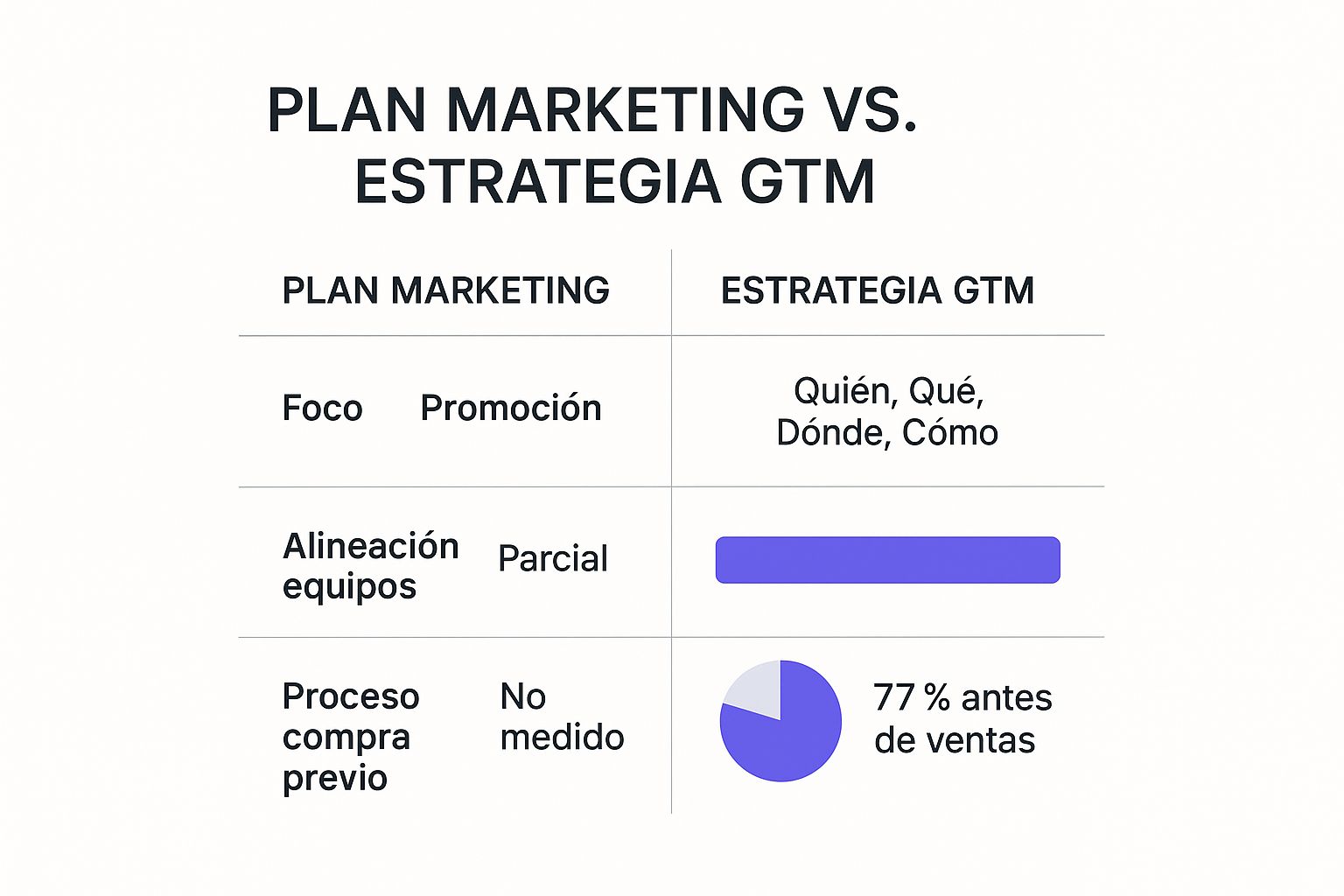
The graphic makes it clear: the GTM strategy covers the entire process to reach the market, not just the promotional part, and that requires all teams to pull in the same direction.
Ultimately, a Go to Market strategy is the bridge that connects your product with revenue. Without that bridge, even the most brilliant product can remain isolated, never reaching the customers who need it.
The reality of GTM in the Spanish market
If we look at the B2B landscape in Spain, the need for a solid GTM strategy becomes even more evident. There is one fact that changes everything: 77% of the B2B buying process occurs before the customer speaks with a sales representative. What does this mean? That the digital experience and high-value content are more crucial than ever.
Although 86% of B2B companies in Spain already use a CRM, the reality is that only 9.7% integrate more advanced technologies such as Intent Data or ABM (Account-Based Marketing). This tells us that many companies still operate with a partial view of their market. Generating qualified leads remains the main headache for 50% of companies, a problem that a well-defined GTM strategy tackles at its root.
How to build the foundations of your GTM plan

A solid GTM strategy is like a good building: if the foundations fail, everything collapses. Before jumping into thinking about marketing channels or advertising campaigns, you must stop and work on the pillars that will support everything.
These elements are not optional. They are the difference between a successful launch and one that passes without pain or glory. The first step, and the most important, is to stop thinking about "the market" as a shapeless mass and start defining with surgical precision whom you are targeting.
Define your ideal customer and your buyer personas
The true starting point of any go to market strategy is the Ideal Customer Profile (ICP). And no, it is not a theoretical concept to fill a PowerPoint. It is a highly specific description of the perfect company for your product or service.
Saying "SMEs in the technology sector" is useless. A good ICP details the specifics. For example, imagine a B2B software company selling a project management tool. Its ICP could be something like: "Software development companies in Spain, with teams of between 50 and 200 people, who use agile methodologies and currently manage with spreadsheets or very basic tools." Do you see the difference? This definition already tells you where to look and what problems they have.
But you do not sell to companies, you sell to people. Therefore, once you have a clear ICP, you need to bring to life those who make the decisions inside. This is where buyer personas come in. It is not enough to know their job title; we need to understand what keeps them up at night.
A practical example of buyer personas
Continuing with the software company, we could define two key profiles:
Carlos, the Chief Technology Officer (CTO): His obsession is team efficiency and meeting deadlines. He is frustrated by a lack of visibility, not knowing where each project stands, and where the bottlenecks are.
Sofía, the Project Manager: Her day-to-day is a chaos of meetings, emails, and task assignments. Her pain point is losing hours in status meetings that a good tool could automate.
Understanding Carlos and Sofía allows you to speak directly to their problems. You stop selling features and start selling solutions to their frustrations.
The difference between a generic ICP and a detailed one is the same as shooting a fairground shotgun versus using a sniper rifle. Precision in this phase will save you thousands of euros in marketing and sales.
Build a value proposition they cannot ignore
With a deep understanding of your customer, the next pillar is your value proposition. Mind you, this is not a pretty slogan. It is a clear and direct statement explaining why a customer should choose you and not the competition.
It must answer three questions, without exception:
What problem do you solve? (Connects directly with your buyer personas' pain points).
How do you solve it? (Explains your solution directly, without beating around the bush or using jargon).
Why are you different? (What is your secret ingredient? What makes you unique?).
Returning to the software example, a powerful value proposition could be: "We help development teams leave behind the chaos of spreadsheets. We centralize communication and automate tracking so they deliver their projects on time. Every single time."
It is direct, focuses on the problem, and promises a clear result. This proposition will become the backbone of all your messaging. From the text of a LinkedIn ad to the script of a sales call, everything must breathe this same idea.
Establish a value-based pricing strategy, not cost-based
And we arrive at price, one of the most delicate issues and where most companies stumble. The classic error is setting the price by looking only at internal costs or, worse, copying the competition. A professional GTM strategy demands value-based pricing.
What does this mean? That your price must reflect the value your customer perceives and receives. If your software saves a company €20,000 a year in project management hours, a price of €5,000 annually is not seen as an expense, but as a very smart investment.
To put it into practice, here are some common B2B pricing models:
Per user/seat: Simple and easy to scale. Ideal for most SaaS tools.
Tiered: You offer different packages with more or fewer features. Facilitates upselling.
Usage-based: The customer pays for what they consume (e.g., number of transactions, GB of storage).
Flat-rate: A single fee to access everything. It is simple but inflexible.
The choice will depend on your product and how your customers derive value from it. And always remember that price communicates. A price that is too low can make your solution look low-quality, while a higher price, well-justified by the value you bring, positions you as a premium solution.
Selecting your B2B sales and marketing channels

You now have the foundations of your go to market strategy. Now comes the exciting part: deciding where and how you are going to find your customer. This is where your plan turns into action, but it is also the point where many B2B companies go wrong, burning budget on channels their ideal customer does not even look at.
I tell you from experience: the key is not to be everywhere. It is to be in the right places with the right message at the right time. This requires an almost detective-like exercise: mapping every possible channel to your customer's buying journey, understanding what they need at each stage, and how they prefer to gather information.
A rookie mistake I see often is copying the competition without a second thought. Just because a channel works for them does not mean it will work for you. Channel selection must be a strategic, tailored decision, not an imitation.
Direct vs. indirect channels
To begin organizing, we can group the options into two large families: direct and indirect sales channels. Each has its pros and cons, and the perfect combination for you will depend on the complexity of your product, the size of your target accounts, and, of course, your resources.
Direct sales channels:
Internal sales team (Inside Sales and Field Sales): This gives you absolute control over the message and the customer relationship. It is almost essential for complex products or high-value sales that require a consultative and personal approach.
Online sales (Self-Service): Ideal for simpler or lower-priced products, where the customer can self-manage the purchase on your website. It reduces acquisition costs, but watch out, it requires a serious investment in marketing to attract that qualified traffic.
Indirect sales channels:
Partner or distributor network: A fantastic way to scale fast and enter new markets, leveraging your partners' customer portfolios. The drawback? You lose some control over the final customer experience.
Affiliate marketing: Partners promote your product in exchange for a commission per sale. It is a model based purely on performance, minimizing your initial risk.
You do not have to choose just one. In fact, combining them is most common. A company can have an inside sales team for mid-market accounts while leveraging a partner network for international expansion.
Channel selection is not just a sales decision; it defines your customer's experience. A direct channel allows you to forge a strong, deep relationship, while an indirect one gives you reach and scalability.
Mapping marketing channels to the customer journey
Great, you now know how you are going to sell. Now you need to know how you are going to generate that demand. Marketing channels are the fuel that feeds your sales engine with high-quality opportunities.
And here, not everything works for everything. Some channels are great for building awareness (the top of the funnel), and others are conversion engines for customers who are already weighing their options.
Let us take a real example. Imagine you sell cybersecurity software to banks, a sector with a long and complex sales cycle. Your channel mix might look like this:
Discovery Stage (Awareness):
Content marketing: Publishing reports on the latest threats in the financial sector or highly technical whitepapers that position the company as an authority.
LinkedIn Ads: Using that content as hook to reach highly specific profiles, such as CISOs (chief information security officers) of banking institutions.
Technical webinars: Hosting online events with experts to educate the market on problems that, coincidentally, your software solves.
Consideration Stage (Consideration):
Case studies: Nothing sells better than demonstrating how other banks have already solved their security issues with your solution.
Email Nurturing: Creating automated and personalized email sequences for those who downloaded the reports, offering them higher-value content.
Account-Based Marketing (ABM): Launching hyper-personalized campaigns for a short list of target banks, combining ads, emails, and calls.
Decision Stage (Decision):
Product demos: Offering one-on-one demonstrations to contacts who have shown clear interest.
Free trials: Letting their technical teams "play" with the tool in a secure, controlled environment.
This multi-channel strategy accompanies the customer at all times, providing value long before asking them to open their wallet.
Things are changing very fast in B2B. Modern GTM strategies rely on hyper-personalization driven by predictive analytics, allowing businesses to anticipate the needs of micro-segments with frightening precision. We are also seeing a much stronger integration with user communities to build more authentic relationships.
Power your GTM with technology and data analysis

In today's B2B environment, launching a product based on intuition is a recipe for disaster. Technology and data analysis are not optional extras; they are the engine that drives every intelligent decision in your go to market strategy, from how you find your first customer to how you close your largest deals.
Ignoring these tools is like trying to cross the ocean with a map drawn on a napkin. You might get there, but it will cost you much more time, money, and frustration. The right technology is your GPS, your weather radar; it allows you to anticipate obstacles and map the shortest, safest route to your objectives.
The CRM as your operations center
A well-configured CRM is much more than a glorified address book. It must be your single source of truth, the meeting point where every interaction from marketing, sales, and customer service makes sense. We are talking about having a true 360-degree view of each account.
Think of a sales representative about to call a lead. With an optimized CRM, they can see at a glance if that person has opened the latest emails, has been browsing the pricing page, or has interacted with a LinkedIn ad. This transforms a cold, awkward call into a relevant, contextual conversation.
The magic of a CRM is not in storing data, but in connecting it. It allows marketing to understand which leads actually convert and sales to know the entire history of an opportunity before picking up the phone.
To go a step further, automation platforms like HubSpot or Marketo integrate with your CRM to nurture leads at scale. With them, you can create automated workflows that send the perfect content to the right person at the right time, qualifying opportunities while you sleep and delivering only contacts that are truly ready to talk to sales.
Artificial intelligence as your sales co-pilot
Artificial intelligence has moved from being a buzzword to becoming an indispensable tactical tool in any modern GTM. Its great power lies in its ability to analyze massive amounts of data and detect patterns that a human being would miss entirely.
And it is not a passing trend. A recent report by Canva reveals how trust in AI is skyrocketing in Spain: 91% of marketing leaders already trust generative AI. Furthermore, 98% of Spanish companies have allocated specific budgets for these technologies in 2024. The data does not lie: you either get on board or get left at the dock.
AI can be applied in very tangible ways in your strategy. Here are some practical examples of how artificial intelligence can boost each phase of your B2B funnel:
Applications of AI in the go to market strategy
GTM Phase | AI Application | Main Benefit |
|---|---|---|
Attraction (ToFu) | Analysis of market trends and creation of SEO-optimized content using AI. | Attract more qualified traffic by identifying topics with high buying intent. |
Consideration (MoFu) | Predictive lead scoring to prioritize contacts with the highest probability of purchase. | The sales team focuses their time on the hottest opportunities. |
Decision (BoFu) | Generation of personalized sales proposals and meeting summaries. | Accelerate the sales cycle and improve communication relevance. |
Retention | Detection of behavioral patterns indicating churn risk. | Act proactively to retain customers before it is too late. |
As you can see, AI is not limited to a single task; it can be a strategic ally throughout the entire customer journey, from discovery to turning them into your best advocates.
From cold calls to data-driven conversations
Technology has also revolutionized prospecting. Sales intelligence tools like LinkedIn Sales Navigator, ZoomInfo, or Cognism have put an end to blind calling. They provide crucial data on companies and contacts, allowing sales representatives to do their homework much faster.
A good SDR no longer just calls. They can identify key buying triggers, such as a recent funding round, the hiring of a new C-level executive, or the posting of a job offer that highlights a specific need.
This approach changes everything. The conversation stops starting with a generic "Do you have a minute?" and becomes a powerful "I noticed you are hiring a development team and was wondering how you manage your projects." The difference in response rate is, quite simply, massive.
Measure what truly matters in your GTM strategy

Launching a go to market strategy is not the finish line; it is the starting gun. This is where the real work begins. Going to market without a clear measurement system is like trying to cross the ocean without a compass: you have plenty of enthusiasm, but no certainty of reaching your destination.
It is very easy to get lost in vanity metrics. Likes on a post or follower growth look great in a report, but they rarely pay the bills. We need to obsess over KPIs that tell us if the business engine is working and if it is sustainable in the long term.
There are two indicators you should have carved in stone: Customer Acquisition Cost (CAC) and Customer Lifetime Value (LTV).
CAC and LTV: the pillars of your profitability
The CAC is quite direct: it tells you exactly how much money it costs to acquire a new customer. To calculate it, simply add up all your marketing and sales expenses over a period (salaries, campaigns, software, etc.) and divide by the number of new customers closed in that same timeframe.
CAC Formula: (Total sales costs + Total marketing costs) / New customers acquired
On the other hand, LTV (Lifetime Value) is a projection. It estimates the total revenue you can expect from a customer over the duration of your business relationship. It is the metric that reveals what a customer is actually worth to you over time.
Its calculation can be more complex, but a simple formula to start is:
Simple LTV Formula: (Average revenue per account) x (Gross margin %) / Churn Rate
Knowing these two numbers in isolation is useful, but the real magic happens when you compare them.
The LTV/CAC ratio is the ultimate health check for your business. It reveals whether you are investing money wisely to grow profitably or if, on the contrary, you are burning cash.
A good benchmark to aim for is a ratio of 3:1 or higher. This means that for every euro you invest in acquiring a customer, you get at least three back. If you are at 1:1, you have a serious profitability problem. And if you exceed 5:1, you could probably afford to be more aggressive with your investments to grow even faster.
Analyze your sales cycle velocity
Another fundamental KPI, especially in B2B, is sales cycle velocity. Basically, it measures the average time that elapses from the first contact with a lead to the signing of the contract.
And why is this so crucial? A shorter sales cycle means revenue comes in faster and your sales team is more efficient. If you suddenly see this cycle lengthening, it is a warning sign. It could indicate that your qualification process is failing, your message is not clear, or there is unnecessary friction during the negotiation phase.
To measure it, calculate the average number of days it takes to close won deals in a specific period. This analysis will help you detect bottlenecks and refine your sales funnel to accelerate results.
Build your dashboard
It is useless to have all this data scattered across a thousand places. You need to centralize it in one single place: your GTM dashboard. The objective is to have a clear, real-time snapshot of your strategy's performance.
But beware, a good dashboard is not a graveyard of charts. It must tell a story. Here is a simple outline to organize yours by key areas:
Customer acquisition metrics
Customer Acquisition Cost (CAC): The actual cost of bringing in a new customer.
Marketing Qualified Leads (MQLs): How many high-quality leads is marketing generating?
Sales Qualified Leads (SQLs): How many of those MQLs does sales accept as real opportunities?
Conversion rate by channel: Which channels (LinkedIn Ads, SEO, outbound...) bring you the best customers at the most efficient cost?
Business and profitability metrics
Customer Lifetime Value (LTV): The revenue generated by a customer over time.
LTV/CAC Ratio: The star indicator of business health and scalability.
Monthly Recurring Revenue (MRR): Essential if you operate with a subscription model.
Sales cycle efficiency metrics
Sales cycle velocity: The average time to close a deal.
Win Rate: The percentage of opportunities your sales team manages to convert into customers.
With a dashboard like this, you will move from making decisions based on intuition to piloting your go to market strategy with surgical precision. You will know exactly which levers to pull to step on the growth accelerator.
Resolving your doubts about Go to Market strategy
Even with the most detailed plan on the table, questions always arise when the moment of truth comes: launching your strategy. This is normal. Let us clear up some of the most common doubts so you can move forward with confidence.
Isn't it the same as a business plan?
This is a common confusion, but they are two very different, though related, things. Think of it this way: the business plan is the complete map of the country, with all its regions, roads, and cities. It covers the entire company: finance, operations, legal structure... the big picture.
In contrast, the GTM strategy is a detailed, zoomed-in map of a single city or specific route. It focuses with surgical precision on how a specific product or service is going to conquer its market. It defines who the customer is, what message we send them, through which channels, and at what price. It is, in essence, a vital chapter within that broader business plan.
How often should I review my strategy?
Your GTM strategy is not a document to print, sign, and archive. It is a living battle plan that needs to adapt to a constantly changing landscape.
The bare minimum recommended is a thorough review once a year. However, there are situations that force you back to the drawing board immediately:
A powerful competitor enters the market and turns everything upside down.
Your customers start buying in a completely new way.
You launch a new feature so significant that it changes your core value proposition.
You decide to target a new market segment or expand into a new geography.
The key is not to wait for disaster. Your key performance indicators (KPIs) are your early warning system. If customer acquisition costs skyrocket or the sales cycle lengthens without explanation, it is an unmistakable sign that you need to review the strategy.
I am a startup, do I really need a GTM strategy?
It is not just that you need it; it is your primary survival tool. For a startup, where every euro and every hour count, a well-defined GTM strategy is what separates success from failure.
Instead of shooting at everything that moves, a good GTM strategy forces you to concentrate your scarce resources on a highly specific niche, known as a beachhead market. This is your entry point to conquer the market.
This approach allows you to validate your product with a small, manageable group of customers, learn at breakneck speed, and build that crucial initial traction. All of this while relying on low-cost, high-impact channels like strong content marketing, building a loyal community, or smart strategic alliances.
Who leads all of this within the company?
Bringing a product to market is a team sport. The GTM strategy must stem from complete collaboration between the leaders of Product, Marketing, and Sales. If these three departments are not perfectly aligned, the strategy is born crippled and is doomed to fail.
That said, someone has to take the lead. Normally, the responsibility for orchestrating and leading the entire process falls on the Product Marketing team. If that role does not exist, the Chief Marketing Officer (CMO) usually takes it on. What matters most is not the job title, but that there is a clear leader ensuring everyone is pulling in the same direction and at the same pace.
At SalesDose, we do not stop at theory. We help you design a GTM strategy and, most importantly, we execute it side-by-side with you. We act as an extension of your team, combining consulting, AI-driven technology, and campaign execution to fill your calendar with qualified meetings and build a predictable sales machine. Discover how we can scale your sales at SalesDose. Book a free consultation now.


Complete the form