
Sales forecast, key points:
Sales forecast: estimation of the revenue to be closed within a period, calculated based on the pipeline.
Most B2B forecasts fail due to over-optimism, not a lack of data.
It is built using historical conversion data per stage, not the sales rep's intuition.
There are two approaches: qualitative (team judgment) and quantitative (historical data and probability).
A reliable forecast depends on a well-managed pipeline, not the other way around.
The sales forecast is one of the most widely used and, at the same time, most poorly calculated tools in B2B sales teams. Practically every company does some version of forecasting; very few actually trust the figure it generates.
The problem is rarely the tool or the CRM, but rather how the sales forecast is constructed. When based on the salesperson's intuition instead of real pipeline data, the figure systematically fails, almost always due to over-optimism.
In this guide, we explain what a sales forecast is, why it fails so often in B2B, and how to build a reliable one step by step. Based on the experience of SalesDose helping B2B sales teams in Spain, UK, and USA project revenue with precision.
What is a sales forecast and why it matters
The sales forecast is the estimation of revenue that a company expects to generate in a given period, calculated from active opportunities in the sales pipeline and their probability of closing. It is not a guess or an aspirational goal: it is a projection based on real data from the sales process.
What a sales forecast is can be better understood by what it enables you to do: plan hiring, adjust marketing budgets, make investment decisions, and communicate realistic expectations to investors or company leadership. An inaccurate forecast does not just misinform sales: it affects the entire operation.
The difference between a useful sales forecast and a useless one is not in the sophistication of the model, but in the discipline with which it is updated. A forecast calculated once a month and not reviewed loses value almost immediately in a B2B sales cycle that changes week by week.
What a sales forecast is can also be understood by what it is not: it is not the commercial goal set by management for the quarter, nor a wishlist from the sales team. It is, specifically, a mathematical projection based on the actual state of the pipeline at the time it is calculated.
Why most B2B forecasts are inaccurate
The reasons why almost all sales forecasts fail in B2B are repeated from company to company:
Salesperson optimism bias. Each salesperson tends to overestimate the closing probability of their own opportunities, especially close to the end of the month or quarter.
Poorly maintained pipeline. If the phases and advancement criteria are not clear, the forecast inherits that inaccuracy directly.
Lack of historical data. Without a record of how many opportunities in each stage actually closed in the past, it is impossible to calibrate the real probability of closing.
Pressure to meet targets. When the forecast is used to evaluate the team, there is an incentive to inflate the numbers instead of reporting them accurately.
The result is a sales forecast that systematically overestimates what will actually close, leading to business decisions based on revenue that never arrives.
How to build a reliable sales forecast step by step
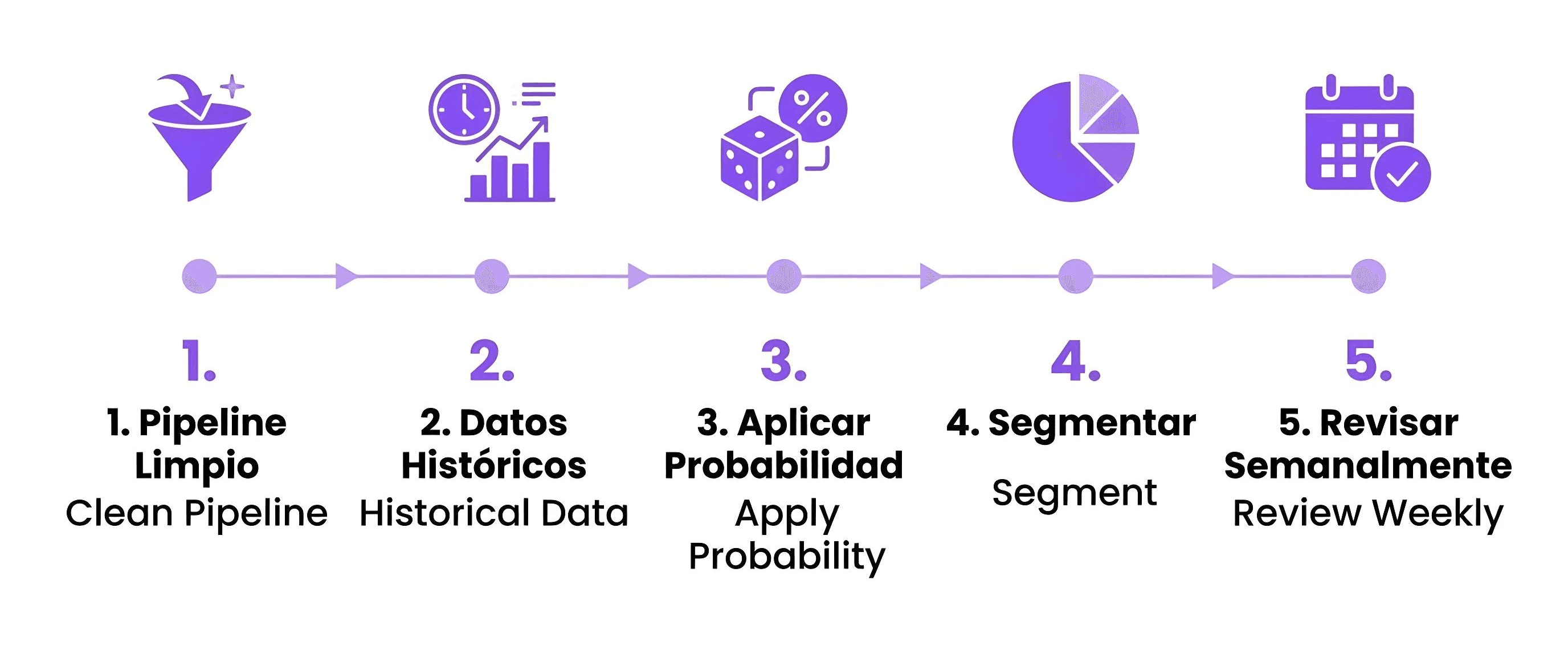
Building a sales forecast you can rely on requires following a specific process:
1. Start with a clean sales pipeline. No forecasting method works if the pipeline has outdated opportunities or lacks real stages. Before calculating the forecast, the pipeline must be cleaned up.
2. Use historical conversion data by stage. Instead of assigning probabilities by eye, calculate the percentage of opportunities in each stage that actually closed in previous periods.
3. Apply that probability to the value of each opportunity. The sales forecast is calculated by multiplying the value of each deal by its real closing probability based on its current stage.
4. Segment by salesperson and client type. Not all sales representatives or segments close at the same rate. An aggregated forecast without this segmentation hides major discrepancies.
5. Review and adjust the forecast weekly. The pipeline changes constantly, so the sales forecast must be recalculated with the same frequency, not once a month.
Making a reliable sales forecast with this method does not eliminate the margin of error, but it reduces it significantly because it is based on the actual behavior of the sales process, not on how each salesperson feels about their opportunities.
Types of forecast: qualitative vs quantitative
Qualitative forecast. Based on the judgment and experience of the sales team and managers, who evaluate each opportunity subjectively. It is quick to do, but more vulnerable to optimism bias.
Quantitative forecast. Based on historical conversion data, pipeline velocity, and statistical probability by stage. It requires more data history, but becomes much more accurate as the company accumulates sales cycles.
In practice, more mature B2B teams combine both approaches: they use the quantitative model as a baseline and the commercial manager's qualitative judgment to adjust specific cases that the model cannot capture, such as a recent change in the client's point of contact.
Tools to automate forecasting
Calculating a sales forecast manually in a spreadsheet is viable with few opportunities, but quickly becomes unfeasible as volume grows. The most common options to automate it are:
CRM with native forecasting. Most B2B CRMs (HubSpot, Salesforce, Pipedrive) include forecasting modules that automatically calculate the projection based on pipeline stages.
Revenue intelligence tools. These analyze historical patterns and signals from sales activity (emails, calls, meetings) to adjust closing probabilities more accurately than manual calculations.
Reporting automation. Dashboards connected to the CRM that update the forecast in real-time, eliminating the manual effort of recalculating it every week.
Whatever the tool, the starting point remains the same as manual sales forecasting: clean pipeline data and probabilities calibrated with real history. Automation accelerates the calculation, but does not replace the quality of the data feeding it.
SalesDose: how we connect forecasting to the sales process
Explaining to the board of directors why the sales forecast missed again is an uncomfortable conversation that repeats quarter after quarter in many B2B companies, almost always for the same reason: the figure was never actually connected to the pipeline.
Our starting point is consultoria estrategica B2B to calibrate closing probabilities with real historical data from your sales cycle, not the optimism of each salesperson. This calculation is automated through processes connected to the CRM, and is sustained over time thanks to our generador digital de leads that keeps the pipeline feeding that forecast always full of real opportunities.
If your sales forecast fails quarter after quarter, hablá con nuestro equipo.
Frequently asked questions about sales forecasting
These are the most common questions that arise when building or reviewing a B2B sales team's sales forecast.
How often should the sales forecast be updated?
Ideally every week. The sales pipeline changes constantly with new opportunities, stage advancements, and closed-lost deals, so a forecast calculated once a month becomes outdated almost immediately and ceases to be useful for timely decision-making.
What margin of error is normal in a sales forecast?
In B2B teams with mature processes, a margin of error of between 10% and 15% against the actual figure is considered acceptable. Larger margins usually indicate issues with pipeline quality, the calculation method, or both.
Does the sales forecast depend on the size of the sales team?
It does not depend as much on size as on the volume of historical data available. Small or new teams with little history must rely more on qualitative forecasting; teams with more accumulated sales cycles can rely more on quantitative models with better accuracy.
What is the difference between a sales forecast and a sales target?
The sales target is the goal the company aims to achieve; the sales forecast is the realistic estimate of what will actually close based on the current state of the pipeline. When these two figures are confused, business decisions are made on a flawed foundation.
Why is my sales forecast always higher than the actual results?
This is the most common pattern, and is almost always due to overly optimistic closing probabilities manually assigned by salespeople. Replacing those subjective estimates with real historical conversion data, following how to build a data-driven sales forecast, usually corrects the issue within a few cycles.
A forecast that fails once is an isolated error. One that fails every quarter is a methodological problem, and methodological problems are corrected, not tolerated.
Did you have to explain why the forecast was missed again this quarter?


Complete the form