The definitive guide to leads to business
The definitive guide to leads to business
The definitive guide to leads to business
Guide
Guide
10 minutes
10 minutes

Leads to business: how to convert B2B prospects into real customers
A lead is not a contact: it is someone who has shown interest and given a signal, the starting point of a relationship, not a guaranteed sale.
The difference between MQL and SQL marks when marketing hands the baton to sales; passing it too early or too late destroys opportunities.
Quality always wins over quantity: a lead that fits your ICP has a higher conversion rate, shorter cycles, and better LTV.
Contacting a new lead in less than five minutes can multiply the chances of qualifying it; automation is the only way to achieve this at scale.
RevOps and automation are the pillars of a predictable conversion engine: they align teams, eliminate friction, and free up sales reps to close.
Converting a lead into business is, in essence, the art of transforming someone's initial interest into a real client, signed contract and all. It is not about collecting names in a database, but rather about guiding those potential clients along their buying journey until they decide to work with you. It is, quite simply, what keeps any company afloat and growing.
What is a lead, really, in the B2B world?
Many make the mistake of thinking that a lead is the same as a contact. A business card handed to you at a trade show, an email on a list… but no. In the real world of sales, a lead is much more than that. It is the seed of a future sale.
Look at it this way: a contact is just a piece of data. A lead, on the other hand, is data with intent. It is someone who has interacted with you, who has shown interest, however small. They have given a signal, a small gesture that says: "Hey, maybe I have a problem and you might have the solution."
Having this distinction clear is key to keeping marketing and sales from being at loggerheads. When both teams understand that a lead is not the finish line, but the starting pistol to build a relationship, everything flows much better.
The difference between a cold contact and a qualified lead
To transform those leads into business efficiently, you must know how to separate the wheat from the chaff. Not all contacts are worth the same, and treating them all equally is the fast track to burning out your team and wasting money.
Cold contact: A company or person that fits your ideal customer profile (ICP), but does not even know you exist. It is a blind bet based on data.
Lead: A contact that has already taken action. They have downloaded your latest report, signed up for a webinar, or requested a demo. There is already an initial "hello" on the table.
Understanding this allows sales teams to focus where it truly matters: on the opportunities that are most likely to convert. Instead of burning out the phone calling endless lists, they can have much higher-value conversations with people who have already raised their hand.
This approach not only drives up conversion rates but also builds a much stronger relationship from the start. To go one step further, it is essential to master consultative selling and its impact on the sales cycle, a methodology that fits like a glove in this lead nurturing process.
The lead as the start of a high-value conversation
In the B2B world, sales do not close in five minutes. Cycles are long and decisions are complex. Therefore, a lead is not a green light to pitch your product, but an invitation to start educating them and earning their trust.
Every email, every call, every piece of content you send must provide value, helping them better understand their own problem and the solutions within reach.
Transforming leads into business is about shifting mindsets: from chasing to attracting, from interrupting to helping. It is about ensuring they see you not as just another vendor, but as the strategic partner they need to make the best decision.
The lead's journey: from first contact to signing
Transforming leads into business is not a magic trick; it is the result of a well-thought-out process. Imagine every lead as a traveler starting a journey: first, they discover your brand, and over time, they come to trust it. You cannot pitch the final destination—the sale—the moment you meet them. The key lies in guiding them, step by step, through each stage of their journey.
This journey is known as the lead lifecycle. If you understand it well, you will know what message to deliver and when, preventing opportunities from being lost along the way. Because no, not all leads are equal, nor are they at the same stage of maturity.
And this is where two concepts that any marketing and sales team must have burned into their minds come into play: MQL and SQL. These are the labels that tell us which stop on the journey our potential client is currently at.
From interest to intent: MQL and SQL
An MQL (Marketing Qualified Lead) is someone who has shown a clear interest in what you offer, but is not yet ready to open their wallet. They have downloaded a guide, watched a webinar, or never miss your newsletters. The marketing team considers them "qualified" because they match your ideal customer profile and their actions show curiosity.
In contrast, an SQL (Sales Qualified Lead) is an MQL that has taken a step further. Their actions are no longer just out of curiosity; they scream "I want to buy." For example, they have requested a demo of your product, asked directly about pricing, or filled out a form for a sales representative to call them.
The transition from MQL to SQL is the moment of truth in the process of turning leads into business. It is the perfect handoff between marketing and sales. If you pass it on too early, you will scare the lead away. If you take too long, they will cool down or, worse, go to the competition.
The following diagram helps you visualize how a lead matures, from that first interaction until they become a client who trusts you.
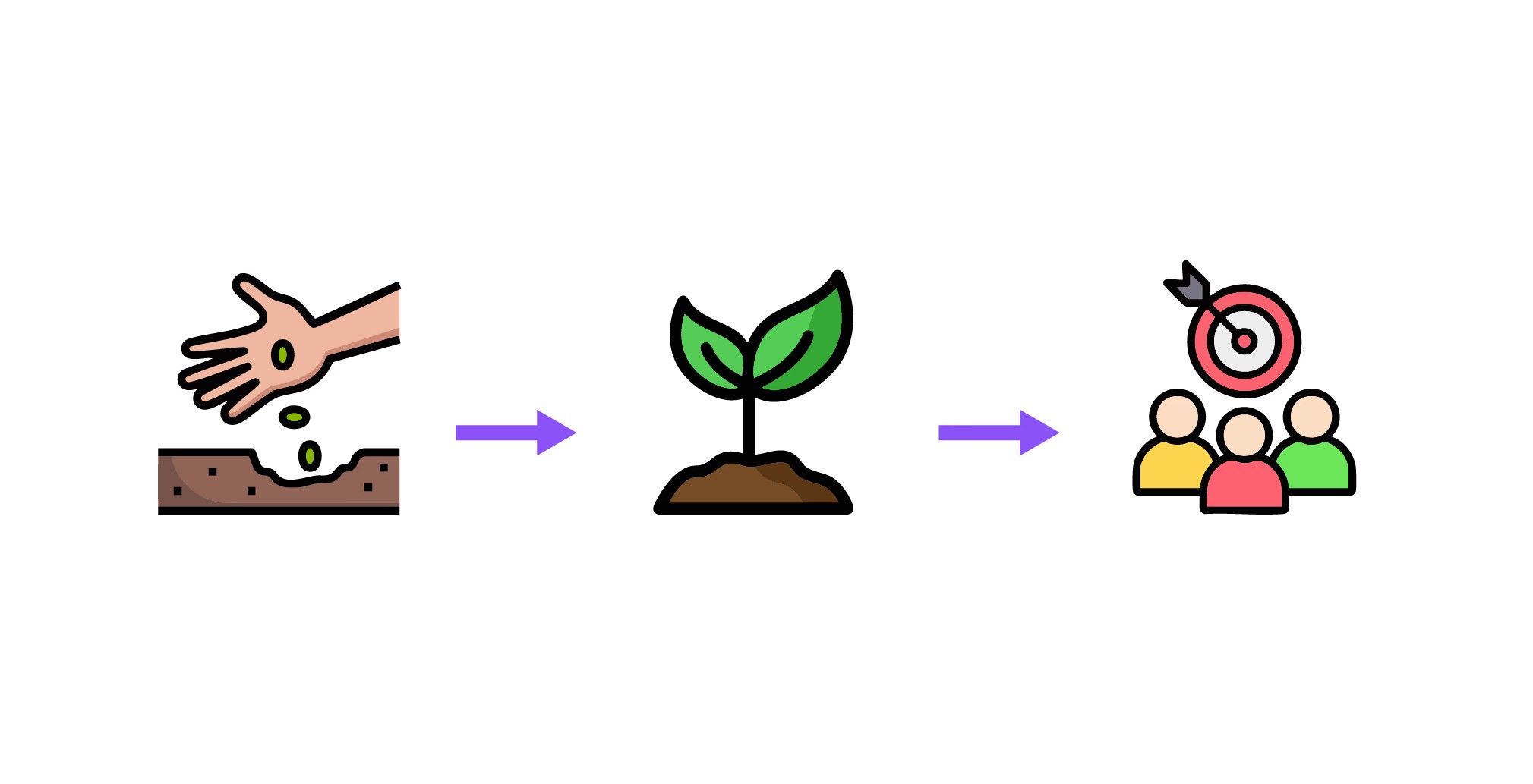
As you can see, the lead's journey is a logical progression. Each stage requires a specific type of attention so that the "seed" of interest eventually germinated and bears fruit.
For this handoff to run like clockwork, it is vital that marketing and sales align on what defines each type of lead. This agreement materializes in lead scoring, a system that assigns points to each lead based on who they are (their job title, sector, company size) and what they do (which pages they visit, which emails they open). When a lead reaches a certain score, they become an SQL and land on a sales rep's desk. If you want to better understand how this entire flow is structured, we recommend reading about how a B2B sales funnel works to see each phase in detail.
Key differences between MQL and SQL
Although both types of leads are crucial, the approach they require is completely different. Clarifying these differences is the first step to avoiding misunderstandings and ensuring everyone is moving in the same direction.
To make it clearer, here is a table summarizing the fundamental differences:
Key differences between MQL and SQL
Qualification Criterion | MQL (Marketing Qualified Lead) | SQL (Sales Qualified Lead) |
|---|---|---|
Interest level | Shows interest in the problem and in learning about potential solutions. | Shows clear purchase intent and evaluates specific vendors. |
Typical actions | Ebook downloads, newsletter subscriptions, webinar attendance. | Demo requests, pricing inquiries, sales call requests. |
Interaction | Nurtured by marketing with automated, educational content. | Contacted directly by the sales team for a conversation. |
Team objective | Educate and build trust to mature the lead's interest. | Qualify the opportunity, understand their needs, and close the sale. |
Understanding this distinction is the foundation for building a predictable revenue-generating engine. While marketing focuses on filling the top of the funnel with quality MQLs, the sales team can dedicate all their energy to SQLs, which are the ones most likely to convert into clients and generate actual business.
Strategies that actually work to maintain a steady flow of leads
Generating a constant stream of leads that convert into business is not a matter of luck; it is pure system. If your strategy is to sit back and wait for opportunities to knock on your door, your company's growth will be unpredictable, to say the least. The key lies in building an acquisition engine that you know works, combining proactive tactics to find clients (outbound) with strategies that attract them to you (inbound).
Forget about magic bullets and shortcuts. What truly delivers results is a well-integrated approach, starting with understanding where your ideal client spends their time and how you can add value in every interaction. Let's break down the tactics that, if executed strategically, will consistently fill your sales pipeline.

The power of multichannel outbound
Today's outbound has nothing to do with cold, untargeted phone calls. Think of it more as a surgical approach, moving across multiple channels simultaneously: the personalization of a good email, a smart interaction on LinkedIn, and, yes, phone calls—but with a strong reason behind them. The goal is no longer to interrupt, but to start conversations with people you know fit your ideal customer profile (ICP) perfectly.
Imagine a flow like this:
Precise identification: First, you must know exactly whom you are targeting. A generic "tech companies" will not cut it. You need something like: "CTOs of SaaS startups with 50 to 200 employees who closed a Series A round in the last 6 months."
Personalized initial contact: You send an email that does not talk about you, but about the problem they are very likely facing. Perhaps you mention a post they published on LinkedIn or a recent milestone of their company.
Social media interaction: A couple of days later, you interact with their content on LinkedIn. Not with a sales pitch, but with a comment that adds value. It is about appearing on their radar naturally.
Call with context: When you finally pick up the phone, you are no longer a complete stranger. You are the person who sent that useful email and commented on their post. Believe me, the conversation starts on much better terms.
This approach turns cold prospecting into something much warmer and, above all, effective. You are laying the groundwork for a relationship of trust from the very first moment.
Inbound marketing: attracting them to you instead of chasing them
While outbound goes out to find clients, inbound marketing acts as a magnet to attract them. It is based on a simple idea: creating and distributing content so valuable that it solves your audience's problems and positions you as an authority in your field.
A lead that arrives through inbound has already done part of the work for you. They have read your content, trust your judgment, and have decided on their own that they want to learn more. This type of lead typically has shorter sales cycles and much higher close rates.
The inbound tactics that work best usually include:
High-value content: Practical guides, ebooks, webinars, or case studies that directly address your client's pain points.
SEO: Optimizing your website and articles so that when someone searches Google for a solution to their problems, they find you first.
Social media advertising: Using ads to promote your valuable content to highly segmented audiences and accelerate the process.
Data from the Spanish market confirms this. A recent study shows that 48.4% of companies view social media ads as the most effective channel for acquiring clients. Not only that, but 77% of companies that use a blog to generate leads secure 67% more qualified contacts than those that do not.
Landing pages and nurturing: do not let a single opportunity slip away
Getting people to your website is only half the battle. If those visitors do not find a clear path to become leads, all your effort goes down the drain. This is where optimized landing pages come into play.
A good landing page has only one goal: to get the visitor to take one specific action, whether downloading a guide or requesting a demo. To do this, it needs a headline that gets straight to the point, a simple form, and zero distractions.
But what about those who download your guide but are not yet ready to buy? This is where the magic of lead nurturing comes into action.
Nurturing is, essentially, guiding those leads through automated email sequences. It is not about bombarding them with offers, but about continuing to provide value, educating them on their problem, and subtly showing them how your solution can be the answer. A good nurturing sequence keeps your brand at the top of their mind until the right moment comes to take the next step.
Metrics that actually matter in your lead strategy
If you want your leads to convert into business, you must stop looking at vanity metrics. "Likes" and impressions do not pay the bills. What truly matters is measuring the actual impact on your bottom line.
Measuring is the only way to know if your efforts are working or if you are simply burning cash. Rigorous tracking allows you to make decisions based on data, not pure intuition, thereby identifying which campaigns are taking off, which ones need adjustment, and ultimately building a predictable growth engine.
Cost per lead (CPL) is not everything
The Cost per Lead (CPL) is one of the first metrics everyone looks at, but also one of the most misunderstood. The formula is simple: divide what you invested in a campaign by the number of leads generated. If you spent €1,000 and obtained 50 leads, your CPL is €20. Simple, right?
The problem is obsessing over lowering that number at all costs. A suspiciously low CPL is often a trap: you might be attracting curious onlookers and people who will never buy anything from you.
A €5 CPL for a lead that does not fit your ideal client profile is €5 thrown in the trash. Conversely, paying €200 for a lead that turns into a €20,000 client is a brilliant investment.
The key lies not in the CPL alone, but in analyzing it alongside the quality of that lead and its actual potential to become a client.
Conversion rate by funnel stage
This is where leaks become visible. The conversion rate is not just about knowing how many leads you close at the end. You must understand how they behave at each stage of the journey, because that will pinpoint where the bottlenecks are.
Measure these key conversions:
Visitor to lead: How many people who land on your landing page end up filling out the form?
Lead to MQL: What percentage of those initial contacts meet the requirements to be qualified by marketing?
MQL to SQL: How many of those MQLs are accepted by the sales team as a real business opportunity?
SQL to client: And finally, what is your close rate?
If you look at these numbers, the issues become obvious. Are you generating many leads but very few MQLs? Perhaps your message is attracting the wrong audience. Do many MQLs stall along the way and fail to reach SQL? This is a clear sign that marketing and sales are not aligned on what constitutes a good lead.
The CPL vs LTV ratio: the ultimate metric
And we arrive at the heart of the matter. The metric that truly tells you if your leads to business strategy is profitable is the one that compares Customer Acquisition Cost (CAC) with Customer Lifetime Value (LTV).
The CAC is everything you invest (in marketing, sales, everything) to acquire a new client. The LTV, on the other hand, is the projected profit you expect to generate from that client throughout your entire relationship. In the B2B world, there is a golden rule: your LTV should be, at a minimum, three times higher than your CAC.
Understanding this relationship is vital. To give you an idea, B2B companies generate an average of 1,877 leads per month, but the cost per lead has risen to $198.44. This proves that it is not about generating for the sake of generating, but about efficiency. It is no surprise that half of marketing professionals state that lead generation is their primary challenge.
To have a clear view of your performance, it is helpful to summarize these concepts in a reference table.
Essential metrics for lead management
Metric | How it is calculated | Why it is important |
|---|---|---|
Cost per Lead (CPL) | Total campaign investment / Number of leads generated | Helps you understand the efficiency of your campaigns, but must always be analyzed alongside lead quality. |
Conversion Rate (by stage) | (Leads in the final stage / Leads in the initial stage) x 100 | Identifies bottlenecks and drop-off points in your sales funnel, allowing you to optimize the process. |
Customer Acquisition Cost (CAC) | Total marketing and sales costs / Number of new clients | Shows how much it actually costs you to acquire a client. It is the total investment, not just the lead cost. |
Customer Lifetime Value (LTV) | (Average deal size x Purchase frequency) x Average customer lifespan | Estimates the total profit a client will bring to your company. It is the metric that justifies the investment in CAC. |
LTV:CAC Ratio | LTV / CAC | The definitive indicator of your business model's profitability. A healthy ratio (ideally >3:1) signifies sustainable growth. |
With these metrics under control, you stop navigating blindly and begin steering your growth strategy with absolute confidence.
How to build a machine to convert leads into business
Converting a lead into a client once in a while is good, but what truly changes the game is setting up a system that does so predictably and scalably. To leave behind manual workload peaks and uncertainty, you need to build a true conversion machine.
This engine does not run by chance. It relies on perfectly integrating technology, processes, and people. The objective is simple: to create a steady, automated flow that finds, nurtures, and delivers sales opportunities ready to close. This way, your team can focus on what they do best.
The Revenue Operations (RevOps) approach: all aligned
The first step in building this machine is breaking down silos. Traditionally, marketing, sales, and customer success teams have operated as independent fiefdoms, each with its own metrics and goals. This only generates friction, lost information, and, ultimately, missed business opportunities.
This is where Revenue Operations (RevOps) comes in. And no, it is not just another buzzword. It is a radical mindset shift that aligns all customer-facing teams under a single strategy and a single set of objectives.
Imagine RevOps as the operating system that runs your revenue engine. Its mission is to ensure that all pieces—marketing, sales, data, and tools—work together seamlessly to drive efficiency and growth. The ultimate goal is to have a 360° view of the customer journey, from the first click to contract renewal.
Automation: your best employee, 24/7
Once the teams are moving in the same direction, technology becomes your great ally. Automation is the heart of this machine, an engine that works tirelessly to execute tasks that, at scale, would be impossible to handle manually.
Imagine having a tireless employee taking care of:
Nurturing every lead: Sending personalized email sequences based on each contact's behavior, delivering the right message at the exact right time.
Measuring interest (Lead Scoring): Assigning points to leads based on their actions (visiting your pricing page, downloading a case study...) and their profile.
Routing leads instantly: When a lead reaches the target score (and becomes an SQL), routing them automatically to the sales rep best prepared to contact them immediately.
These tools are not meant to replace your team, but to give them superpowers. They free your sales reps from repetitive tasks so they can focus on the conversations that truly matter. Indeed, the data speaks for itself: 80% of Spanish companies have noted a clear increase in client acquisition after implementing automation. Interestingly, nearly half (48.6%) do not use it yet, which represents a massive competitive advantage for those who do.
A repeatable system you can scale
The true power of this machine lies in its predictability. When you systematize how you generate and qualify leads, you can suddenly begin forecasting future revenue with a precision that was previously unthinkable.
To make this system run like clockwork, you need three pillars:
Unified technology: A robust CRM as the brain of the operation, where all information is centralized and connected to your marketing tools.
Enriched data: Processes to ensure your lead information is accurate and up to date. This is key to true segmentation and personalization.
Clear processes: An instruction manual (or playbook) detailing every step of the lead journey, from the moment they enter to the moment they become a client.
By combining the RevOps strategy, the power of automation, and a data-obsessed approach, you stop relying on luck. You create a growth engine that never stops, allowing your internal or outsourced SDRs team to focus solely on closing deals and taking your business to the next level.
Frequently asked questions: from lead to business
Even with the most polished strategy, daily questions always arise when trying to transform leads into business. Here, we have gathered the most common ones to give you direct, straightforward answers to help clear the path and fine-tune your sales process.
What is the difference between a lead and a prospect?
Many people use them interchangeably, but in practice, they are not the same. Think of a lead as the starting point: someone who has shown initial interest, perhaps by downloading an ebook or signing up for your newsletter. It is a signal, nothing more.
A prospect, on the other hand, has moved up a step. It is a lead we have closely vetted and confirmed two things: they match our Ideal Customer Profile (ICP), and their interest is genuine. They have a problem we know how to solve.
The key lies in qualification. Converting a lead into a prospect is a small victory that tells your sales team: "hey, there is something here worthy of your time."
How long should I take to contact a new lead?
Here, speed is everything. Studies make it very clear: if you contact a lead within the first five minutes, your chances of qualifying them skyrocket. Every minute you let pass is an opportunity for their interest to cool down or for a competitor to get ahead of you.
But beware, this is not about your team constantly refreshing the page. The solution is automation. You need a system that alerts and assigns leads instantly. This way, the response arrives precisely when that person's curiosity is at its peak.
Do I prioritize lead quantity or quality?
Quality. Always. Filling the funnel with hundreds of leads that do not fit is the fastest way to burn out your sales team and waste money.
It is much smarter to focus on generating fewer leads that are exactly the type of client you are looking for. Why? Because these high-quality contacts bring major advantages:
Higher conversion rate: Naturally, their problems connect directly with your solution.
Shorter sales cycles: Conversations flow because there is no need to force a fit.
Better LTV (Customer Lifetime Value): They become more satisfied clients who stay longer and spend more.
What role does content play in lead nurturing?
Content is the engine of lead nurturing. It is your best ally to keep the conversation alive with those leads who are not yet ready to buy.
Its objective is twofold: to educate and to build trust. When you send a well-planned sequence of emails with articles, case studies, or invitations to a webinar, you achieve two things. First, you keep your brand on their radar. Second, you help them better understand their own problem, positioning yourself as the authority that can help them. This way, when they are finally ready to decide, your name will be the first that comes to mind.
At SalesDose, we do not limit ourselves to generating leads. We build the entire system to convert those leads into predictable revenue for your business. We design and implement multichannel acquisition engines, fine-tune your operations with RevOps and AI, and ensure your sales team only spends their time talking to real opportunities.
Schedule a call and discover how we can scale your sales.
Converting a lead into business is, in essence, the art of transforming someone's initial interest into a real client, signed contract and all. It is not about collecting names in a database, but rather about guiding those potential clients along their buying journey until they decide to work with you. It is, quite simply, what keeps any company afloat and growing.
What is a lead, really, in the B2B world?
Many make the mistake of thinking that a lead is the same as a contact. A business card handed to you at a trade show, an email on a list… but no. In the real world of sales, a lead is much more than that. It is the seed of a future sale.
Look at it this way: a contact is just a piece of data. A lead, on the other hand, is data with intent. It is someone who has interacted with you, who has shown interest, however small. They have given a signal, a small gesture that says: "Hey, maybe I have a problem and you might have the solution."
Having this distinction clear is key to keeping marketing and sales from being at loggerheads. When both teams understand that a lead is not the finish line, but the starting pistol to build a relationship, everything flows much better.
The difference between a cold contact and a qualified lead
To transform those leads into business efficiently, you must know how to separate the wheat from the chaff. Not all contacts are worth the same, and treating them all equally is the fast track to burning out your team and wasting money.
Cold contact: A company or person that fits your ideal customer profile (ICP), but does not even know you exist. It is a blind bet based on data.
Lead: A contact that has already taken action. They have downloaded your latest report, signed up for a webinar, or requested a demo. There is already an initial "hello" on the table.
Understanding this allows sales teams to focus where it truly matters: on the opportunities that are most likely to convert. Instead of burning out the phone calling endless lists, they can have much higher-value conversations with people who have already raised their hand.
This approach not only drives up conversion rates but also builds a much stronger relationship from the start. To go one step further, it is essential to master consultative selling and its impact on the sales cycle, a methodology that fits like a glove in this lead nurturing process.
The lead as the start of a high-value conversation
In the B2B world, sales do not close in five minutes. Cycles are long and decisions are complex. Therefore, a lead is not a green light to pitch your product, but an invitation to start educating them and earning their trust.
Every email, every call, every piece of content you send must provide value, helping them better understand their own problem and the solutions within reach.
Transforming leads into business is about shifting mindsets: from chasing to attracting, from interrupting to helping. It is about ensuring they see you not as just another vendor, but as the strategic partner they need to make the best decision.
The lead's journey: from first contact to signing
Transforming leads into business is not a magic trick; it is the result of a well-thought-out process. Imagine every lead as a traveler starting a journey: first, they discover your brand, and over time, they come to trust it. You cannot pitch the final destination—the sale—the moment you meet them. The key lies in guiding them, step by step, through each stage of their journey.
This journey is known as the lead lifecycle. If you understand it well, you will know what message to deliver and when, preventing opportunities from being lost along the way. Because no, not all leads are equal, nor are they at the same stage of maturity.
And this is where two concepts that any marketing and sales team must have burned into their minds come into play: MQL and SQL. These are the labels that tell us which stop on the journey our potential client is currently at.
From interest to intent: MQL and SQL
An MQL (Marketing Qualified Lead) is someone who has shown a clear interest in what you offer, but is not yet ready to open their wallet. They have downloaded a guide, watched a webinar, or never miss your newsletters. The marketing team considers them "qualified" because they match your ideal customer profile and their actions show curiosity.
In contrast, an SQL (Sales Qualified Lead) is an MQL that has taken a step further. Their actions are no longer just out of curiosity; they scream "I want to buy." For example, they have requested a demo of your product, asked directly about pricing, or filled out a form for a sales representative to call them.
The transition from MQL to SQL is the moment of truth in the process of turning leads into business. It is the perfect handoff between marketing and sales. If you pass it on too early, you will scare the lead away. If you take too long, they will cool down or, worse, go to the competition.
The following diagram helps you visualize how a lead matures, from that first interaction until they become a client who trusts you.
As you can see, the lead's journey is a logical progression. Each stage requires a specific type of attention so that the "seed" of interest eventually germinated and bears fruit.
For this handoff to run like clockwork, it is vital that marketing and sales align on what defines each type of lead. This agreement materializes in lead scoring, a system that assigns points to each lead based on who they are (their job title, sector, company size) and what they do (which pages they visit, which emails they open). When a lead reaches a certain score, they become an SQL and land on a sales rep's desk. If you want to better understand how this entire flow is structured, we recommend reading about how a B2B sales funnel works to see each phase in detail.
Key differences between MQL and SQL
Although both types of leads are crucial, the approach they require is completely different. Clarifying these differences is the first step to avoiding misunderstandings and ensuring everyone is moving in the same direction.
To make it clearer, here is a table summarizing the fundamental differences:
Key differences between MQL and SQL
Qualification Criterion | MQL (Marketing Qualified Lead) | SQL (Sales Qualified Lead) |
|---|---|---|
Interest level | Shows interest in the problem and in learning about potential solutions. | Shows clear purchase intent and evaluates specific vendors. |
Typical actions | Ebook downloads, newsletter subscriptions, webinar attendance. | Demo requests, pricing inquiries, sales call requests. |
Interaction | Nurtured by marketing with automated, educational content. | Contacted directly by the sales team for a conversation. |
Team objective | Educate and build trust to mature the lead's interest. | Qualify the opportunity, understand their needs, and close the sale. |
Understanding this distinction is the foundation for building a predictable revenue-generating engine. While marketing focuses on filling the top of the funnel with quality MQLs, the sales team can dedicate all their energy to SQLs, which are the ones most likely to convert into clients and generate actual business.
Strategies that actually work to maintain a steady flow of leads
Generating a constant stream of leads that convert into business is not a matter of luck; it is pure system. If your strategy is to sit back and wait for opportunities to knock on your door, your company's growth will be unpredictable, to say the least. The key lies in building an acquisition engine that you know works, combining proactive tactics to find clients (outbound) with strategies that attract them to you (inbound).
Forget about magic bullets and shortcuts. What truly delivers results is a well-integrated approach, starting with understanding where your ideal client spends their time and how you can add value in every interaction. Let's break down the tactics that, if executed strategically, will consistently fill your sales pipeline.
The power of multichannel outbound
Today's outbound has nothing to do with cold, untargeted phone calls. Think of it more as a surgical approach, moving across multiple channels simultaneously: the personalization of a good email, a smart interaction on LinkedIn, and, yes, phone calls—but with a strong reason behind them. The goal is no longer to interrupt, but to start conversations with people you know fit your ideal customer profile (ICP) perfectly.
Imagine a flow like this:
Precise identification: First, you must know exactly whom you are targeting. A generic "tech companies" will not cut it. You need something like: "CTOs of SaaS startups with 50 to 200 employees who closed a Series A round in the last 6 months."
Personalized initial contact: You send an email that does not talk about you, but about the problem they are very likely facing. Perhaps you mention a post they published on LinkedIn or a recent milestone of their company.
Social media interaction: A couple of days later, you interact with their content on LinkedIn. Not with a sales pitch, but with a comment that adds value. It is about appearing on their radar naturally.
Call with context: When you finally pick up the phone, you are no longer a complete stranger. You are the person who sent that useful email and commented on their post. Believe me, the conversation starts on much better terms.
This approach turns cold prospecting into something much warmer and, above all, effective. You are laying the groundwork for a relationship of trust from the very first moment.
Inbound marketing: attracting them to you instead of chasing them
While outbound goes out to find clients, inbound marketing acts as a magnet to attract them. It is based on a simple idea: creating and distributing content so valuable that it solves your audience's problems and positions you as an authority in your field.
A lead that arrives through inbound has already done part of the work for you. They have read your content, trust your judgment, and have decided on their own that they want to learn more. This type of lead typically has shorter sales cycles and much higher close rates.
The inbound tactics that work best usually include:
High-value content: Practical guides, ebooks, webinars, or case studies that directly address your client's pain points.
SEO: Optimizing your website and articles so that when someone searches Google for a solution to their problems, they find you first.
Social media advertising: Using ads to promote your valuable content to highly segmented audiences and accelerate the process.
Data from the Spanish market confirms this. A recent study shows that 48.4% of companies view social media ads as the most effective channel for acquiring clients. Not only that, but 77% of companies that use a blog to generate leads secure 67% more qualified contacts than those that do not.
Landing pages and nurturing: do not let a single opportunity slip away
Getting people to your website is only half the battle. If those visitors do not find a clear path to become leads, all your effort goes down the drain. This is where optimized landing pages come into play.
A good landing page has only one goal: to get the visitor to take one specific action, whether downloading a guide or requesting a demo. To do this, it needs a headline that gets straight to the point, a simple form, and zero distractions.
But what about those who download your guide but are not yet ready to buy? This is where the magic of lead nurturing comes into action.
Nurturing is, essentially, guiding those leads through automated email sequences. It is not about bombarding them with offers, but about continuing to provide value, educating them on their problem, and subtly showing them how your solution can be the answer. A good nurturing sequence keeps your brand at the top of their mind until the right moment comes to take the next step.
Metrics that actually matter in your lead strategy
If you want your leads to convert into business, you must stop looking at vanity metrics. "Likes" and impressions do not pay the bills. What truly matters is measuring the actual impact on your bottom line.
Measuring is the only way to know if your efforts are working or if you are simply burning cash. Rigorous tracking allows you to make decisions based on data, not pure intuition, thereby identifying which campaigns are taking off, which ones need adjustment, and ultimately building a predictable growth engine.
Cost per lead (CPL) is not everything
The Cost per Lead (CPL) is one of the first metrics everyone looks at, but also one of the most misunderstood. The formula is simple: divide what you invested in a campaign by the number of leads generated. If you spent €1,000 and obtained 50 leads, your CPL is €20. Simple, right?
The problem is obsessing over lowering that number at all costs. A suspiciously low CPL is often a trap: you might be attracting curious onlookers and people who will never buy anything from you.
A €5 CPL for a lead that does not fit your ideal client profile is €5 thrown in the trash. Conversely, paying €200 for a lead that turns into a €20,000 client is a brilliant investment.
The key lies not in the CPL alone, but in analyzing it alongside the quality of that lead and its actual potential to become a client.
Conversion rate by funnel stage
This is where leaks become visible. The conversion rate is not just about knowing how many leads you close at the end. You must understand how they behave at each stage of the journey, because that will pinpoint where the bottlenecks are.
Measure these key conversions:
Visitor to lead: How many people who land on your landing page end up filling out the form?
Lead to MQL: What percentage of those initial contacts meet the requirements to be qualified by marketing?
MQL to SQL: How many of those MQLs are accepted by the sales team as a real business opportunity?
SQL to client: And finally, what is your close rate?
If you look at these numbers, the issues become obvious. Are you generating many leads but very few MQLs? Perhaps your message is attracting the wrong audience. Do many MQLs stall along the way and fail to reach SQL? This is a clear sign that marketing and sales are not aligned on what constitutes a good lead.
The CPL vs LTV ratio: the ultimate metric
And we arrive at the heart of the matter. The metric that truly tells you if your leads to business strategy is profitable is the one that compares Customer Acquisition Cost (CAC) with Customer Lifetime Value (LTV).
The CAC is everything you invest (in marketing, sales, everything) to acquire a new client. The LTV, on the other hand, is the projected profit you expect to generate from that client throughout your entire relationship. In the B2B world, there is a golden rule: your LTV should be, at a minimum, three times higher than your CAC.
Understanding this relationship is vital. To give you an idea, B2B companies generate an average of 1,877 leads per month, but the cost per lead has risen to $198.44. This proves that it is not about generating for the sake of generating, but about efficiency. It is no surprise that half of marketing professionals state that lead generation is their primary challenge.
To have a clear view of your performance, it is helpful to summarize these concepts in a reference table.
Essential metrics for lead management
Metric | How it is calculated | Why it is important |
|---|---|---|
Cost per Lead (CPL) | Total campaign investment / Number of leads generated | Helps you understand the efficiency of your campaigns, but must always be analyzed alongside lead quality. |
Conversion Rate (by stage) | (Leads in the final stage / Leads in the initial stage) x 100 | Identifies bottlenecks and drop-off points in your sales funnel, allowing you to optimize the process. |
Customer Acquisition Cost (CAC) | Total marketing and sales costs / Number of new clients | Shows how much it actually costs you to acquire a client. It is the total investment, not just the lead cost. |
Customer Lifetime Value (LTV) | (Average deal size x Purchase frequency) x Average customer lifespan | Estimates the total profit a client will bring to your company. It is the metric that justifies the investment in CAC. |
LTV:CAC Ratio | LTV / CAC | The definitive indicator of your business model's profitability. A healthy ratio (ideally >3:1) signifies sustainable growth. |
With these metrics under control, you stop navigating blindly and begin steering your growth strategy with absolute confidence.
How to build a machine to convert leads into business
Converting a lead into a client once in a while is good, but what truly changes the game is setting up a system that does so predictably and scalably. To leave behind manual workload peaks and uncertainty, you need to build a true conversion machine.
This engine does not run by chance. It relies on perfectly integrating technology, processes, and people. The objective is simple: to create a steady, automated flow that finds, nurtures, and delivers sales opportunities ready to close. This way, your team can focus on what they do best.
The Revenue Operations (RevOps) approach: all aligned
The first step in building this machine is breaking down silos. Traditionally, marketing, sales, and customer success teams have operated as independent fiefdoms, each with its own metrics and goals. This only generates friction, lost information, and, ultimately, missed business opportunities.
This is where Revenue Operations (RevOps) comes in. And no, it is not just another buzzword. It is a radical mindset shift that aligns all customer-facing teams under a single strategy and a single set of objectives.
Imagine RevOps as the operating system that runs your revenue engine. Its mission is to ensure that all pieces—marketing, sales, data, and tools—work together seamlessly to drive efficiency and growth. The ultimate goal is to have a 360° view of the customer journey, from the first click to contract renewal.
Automation: your best employee, 24/7
Once the teams are moving in the same direction, technology becomes your great ally. Automation is the heart of this machine, an engine that works tirelessly to execute tasks that, at scale, would be impossible to handle manually.
Imagine having a tireless employee taking care of:
Nurturing every lead: Sending personalized email sequences based on each contact's behavior, delivering the right message at the exact right time.
Measuring interest (Lead Scoring): Assigning points to leads based on their actions (visiting your pricing page, downloading a case study...) and their profile.
Routing leads instantly: When a lead reaches the target score (and becomes an SQL), routing them automatically to the sales rep best prepared to contact them immediately.
These tools are not meant to replace your team, but to give them superpowers. They free your sales reps from repetitive tasks so they can focus on the conversations that truly matter. Indeed, the data speaks for itself: 80% of Spanish companies have noted a clear increase in client acquisition after implementing automation. Interestingly, nearly half (48.6%) do not use it yet, which represents a massive competitive advantage for those who do.
A repeatable system you can scale
The true power of this machine lies in its predictability. When you systematize how you generate and qualify leads, you can suddenly begin forecasting future revenue with a precision that was previously unthinkable.
To make this system run like clockwork, you need three pillars:
Unified technology: A robust CRM as the brain of the operation, where all information is centralized and connected to your marketing tools.
Enriched data: Processes to ensure your lead information is accurate and up to date. This is key to true segmentation and personalization.
Clear processes: An instruction manual (or playbook) detailing every step of the lead journey, from the moment they enter to the moment they become a client.
By combining the RevOps strategy, the power of automation, and a data-obsessed approach, you stop relying on luck. You create a growth engine that never stops, allowing your internal or outsourced SDRs team to focus solely on closing deals and taking your business to the next level.
Frequently asked questions: from lead to business
Even with the most polished strategy, daily questions always arise when trying to transform leads into business. Here, we have gathered the most common ones to give you direct, straightforward answers to help clear the path and fine-tune your sales process.
What is the difference between a lead and a prospect?
Many people use them interchangeably, but in practice, they are not the same. Think of a lead as the starting point: someone who has shown initial interest, perhaps by downloading an ebook or signing up for your newsletter. It is a signal, nothing more.
A prospect, on the other hand, has moved up a step. It is a lead we have closely vetted and confirmed two things: they match our Ideal Customer Profile (ICP), and their interest is genuine. They have a problem we know how to solve.
The key lies in qualification. Converting a lead into a prospect is a small victory that tells your sales team: "hey, there is something here worthy of your time."
How long should I take to contact a new lead?
Here, speed is everything. Studies make it very clear: if you contact a lead within the first five minutes, your chances of qualifying them skyrocket. Every minute you let pass is an opportunity for their interest to cool down or for a competitor to get ahead of you.
But beware, this is not about your team constantly refreshing the page. The solution is automation. You need a system that alerts and assigns leads instantly. This way, the response arrives precisely when that person's curiosity is at its peak.
Do I prioritize lead quantity or quality?
Quality. Always. Filling the funnel with hundreds of leads that do not fit is the fastest way to burn out your sales team and waste money.
It is much smarter to focus on generating fewer leads that are exactly the type of client you are looking for. Why? Because these high-quality contacts bring major advantages:
Higher conversion rate: Naturally, their problems connect directly with your solution.
Shorter sales cycles: Conversations flow because there is no need to force a fit.
Better LTV (Customer Lifetime Value): They become more satisfied clients who stay longer and spend more.
What role does content play in lead nurturing?
Content is the engine of lead nurturing. It is your best ally to keep the conversation alive with those leads who are not yet ready to buy.
Its objective is twofold: to educate and to build trust. When you send a well-planned sequence of emails with articles, case studies, or invitations to a webinar, you achieve two things. First, you keep your brand on their radar. Second, you help them better understand their own problem, positioning yourself as the authority that can help them. This way, when they are finally ready to decide, your name will be the first that comes to mind.
At SalesDose, we do not limit ourselves to generating leads. We build the entire system to convert those leads into predictable revenue for your business. We design and implement multichannel acquisition engines, fine-tune your operations with RevOps and AI, and ensure your sales team only spends their time talking to real opportunities.
Schedule a call and discover how we can scale your sales.
Featured Content Area


Complete the form
Start optimizing your sales process today
Start Optimizing Your Sales Process with AI Today!
If you want to accelerate your company’s growth and improve your sales pipeline, complete the form below. We will contact you as soon as possible and help you design a tailored Action Plan.
Discover how our AI sales tool can transform your B2B sales funnel and increase your conversions. Schedule your free consultation and take the first step toward AI-powered sales automation that will improve your business results.
Discover how our AI sales tool can transform your B2B sales funnel and increase your conversions. Schedule your free consultation and take the first step toward AI-powered sales automation that will improve your business results.