
Sales representative, key points:
Sales agent: an independent professional who sells for a company in exchange for a commission, without being on the payroll.
No fixed salary: they are paid based on results, which reduces the financial risk for the company.
Regulated in Spain by Law 12/1992 on Agency Contracts.
Functions of a sales agent: prospecting, negotiation, closing, and account management.
They do not always replace an in-house sales team: it depends on the complexity of the sales process.
A sales agent is one of the oldest figures in the business world, and still raises doubts when it comes to structuring a sales team in B2B. Many founders and sales directors reach this decision without being clear on what it actually entails: whether they are an employee in disguise, an independent contractor with more freedom, or a completely different model of selling.
This confusion carries a cost. Hiring a sales agent without understanding their functions, legal framework, and limitations usually leads to misaligned expectations, both for the company and the agent themselves.
In this guide, we explain what a sales agent is, what functions they perform, how they differ from an in-house sales representative, and when this model makes sense for a B2B company. Based on SalesDose's experience structuring sales teams for B2B companies in Spain, the UK, and the USA.
What is a sales agent
A sales agent is an independent professional who sells a company's products or services in exchange for a commission, without being part of its payroll. They do not have an employment contract with the company they represent: they work as an independent contractor or through their own structure, and their income depends directly on the results they achieve.
In the B2B context, this figure is primarily used to enter new markets, expand geographical areas, or cover sectors where the company does not yet have its own business relationships. The sales agent brings their portfolio of contacts and local knowledge; the company provides the product, price, and sales conditions.
In Spain, the relationship between a sales agent and the company they represent is regulated by Law 12/1992 on the Agency Contract. This law defines the minimum notice period to terminate the contract, the agent's right to goodwill compensation in certain cases, and the conditions under which exclusivity may or may not be agreed upon.
Unlike an employee, the sales agent assumes the risk of not selling: if they do not generate results, they do not get paid, unless some form of guaranteed minimum has been agreed upon. This makes the model a low financial risk option for the company, although it is not free from other risks, such as relying on a single person to represent the brand across an entire territory.

Functions of a sales agent in B2B
The functions of a sales agent typically include:
Prospecting and acquisition. Identifies and contacts potential clients within the assigned sector or territory.
Sales negotiation. Presents the product or service, addresses objections, and negotiates terms within the margins authorized by the company.
Closing sales. In many cases, manages the order or contract through to its final signature.
Account follow-up. Maintains the relationship with the client post-sale, especially if working on commission from recurring sales.
Market intelligence. Provides information on competition, pricing, and sector needs, being in direct contact with the field.
These functions of a sales agent vary significantly by sector: in the industrial sector, they usually focus on face-to-face visits and long-term relationships with a few high-value clients; in professional services, they focus on active prospecting, value proposition, and shorter sales cycles.
It is worth clarifying that, unless expressly agreed, the functions of a sales agent do not include internal management tasks such as invoicing, post-sales technical support, or product support. When a company expects broader functions, such as onboarding or customer success, it is best to put this in writing from the start to avoid conflicting expectations.
Sales agent vs in-house sales rep: key differences
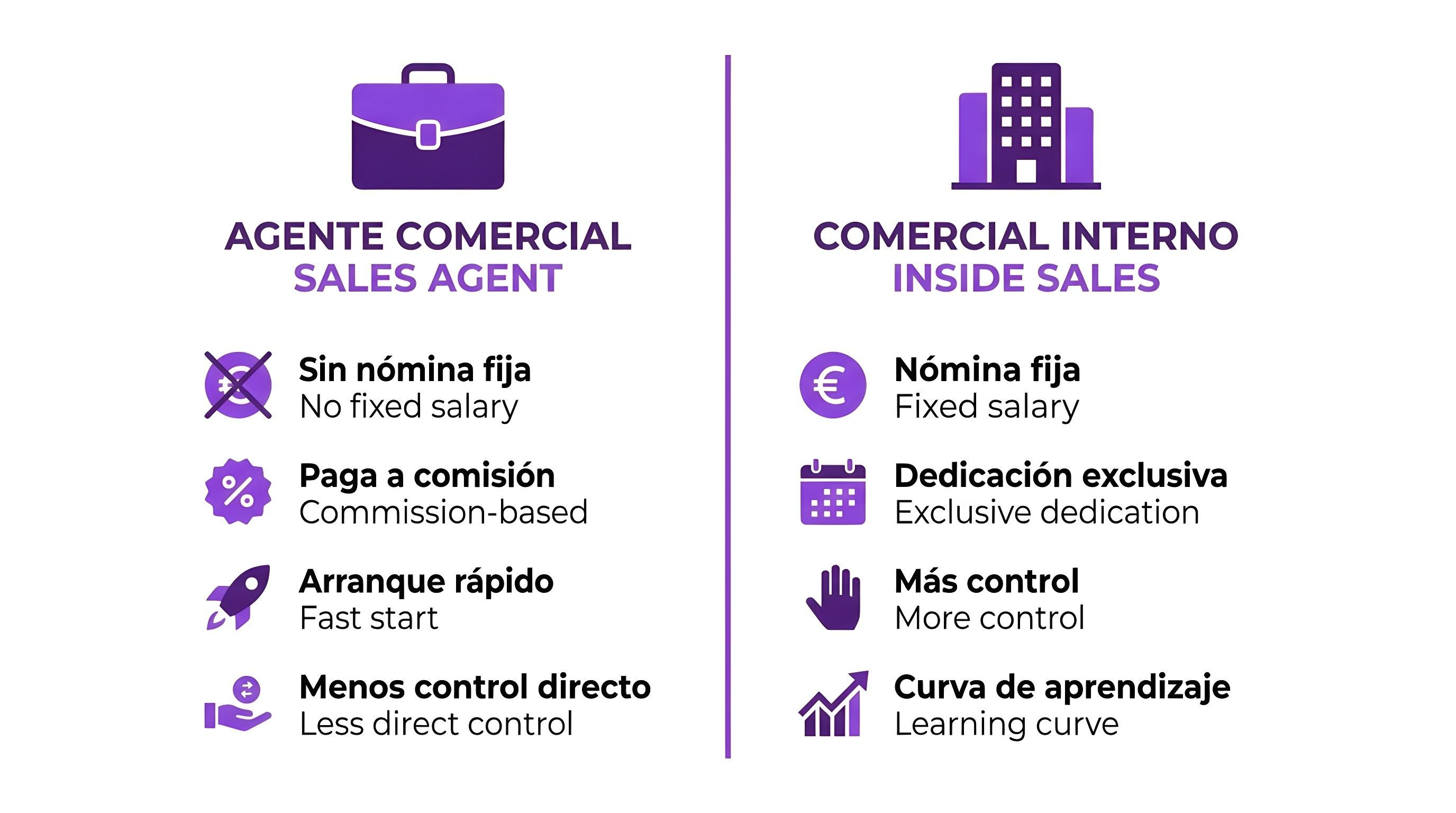
The most common comparison when structuring a sales team is between a sales agent and an in-house sales representative (payroll employee). The most important differences are:
Relationship. The sales agent is an independent contractor; the in-house rep has an employment contract.
Cost. The agent earns on commission (variable cost); the in-house rep has a fixed salary (fixed cost).
Control. The in-house sales rep follows internal guidelines and processes more closely; the agent acts with greater autonomy.
Ramp-up. The sales agent usually starts faster, as they bring their own contact portfolio.
Dedication. The in-house rep works exclusively for the company; the agent can represent multiple brands simultaneously.
Advantages and disadvantages of the model
Like any sales model, working with a sales agent brings clear benefits as well as commitments that should be understood before signing any agreement.
Advantages of working with a sales agent
Variable cost, not fixed: payment is based on results.
Fast entry into new markets or territories.
Access to an established portfolio of contacts.
Lower risk if the market does not respond as expected.
This last point is often the most decisive for companies testing a market for the first time: instead of investing in a full in-house team without knowing if the product will succeed there, the sales agent model allows for testing with a much lower financial commitment.
Disadvantages to consider
Less control over the sales pitch and customer experience.
Reliance on the agent's individual motivation.
Difficulty scaling the model across multiple markets simultaneously.
The issue of individual reliance worsens when the sales agent represents multiple brands at the same time: their attention and time are divided, and there is no guarantee that your company will receive priority over other brands in their portfolio.
Many B2B companies resolve this balance by combining external sales agents with an in-house team that maintains control over the process. If you are looking for that control without sacrificing speed, at SalesDose we structure prospección comercial teams that operate as a direct extension of your company, rather than a disconnected external agent.
When it makes sense and when it does not for a B2B company
Understanding what a sales agent is and what functions they perform is only half the decision. The other half is knowing if your company is at the right stage for this model. Hiring a sales agent usually makes sense when:
The company wants to test a new market without assuming fixed costs.
The sales cycle is relatively simple and does not require extensive technical support.
There is an agent with a relevant, pre-existing portfolio in that sector.
The budget available for business development is limited in the initial phase.
Conversely, it is usually not the best option when:
The sales process is complex and requires constant follow-up from the in-house team.
The company depends on a highly controlled customer experience from the very first contact.
The goal is to build a long-term business relationship, not just to close a one-off sale.
The product requires a steep technical learning curve that an external agent can hardly sustain without continuous training.
A practical way to decide is to ask what would happen if the sales agent stopped working with the company tomorrow: if the answer is that the entire relationship with those clients is lost, the model is likely creating more dependency than is advisable.
Types of sales agents
Once it is clear what a sales agent is, it is helpful to distinguish between the existing types, as not all operate in the same way or fit every company.
Exclusive sales agent. Works solely for one company within their territory, in exchange for a typically higher commission that compensates for exclusivity.
Multi-portfolio sales agent. Represents several non-competing brands or companies simultaneously, dividing their time among them.
Sector-specific sales agent. Specialized in a concrete sector (industrial, technological, services), providing technical knowledge and high-quality contacts within that niche.
Geographical area sales agent. Covers a specific region or country, useful when international expansion is the main goal.
Choosing among these types of sales agents depends on the objective: if full dedication is sought, exclusivity usually offsets the higher cost; if the goal is simply to test the waters with low commitment, a multi-portfolio agent may be sufficient to start.
Suggested Image 3 (conceptual photography, without text): two professionals shaking hands in a modern and bright office, open laptop in the background, conveying the closing of a business agreement. Warm and professional tone, without text or visible logos.
SalesDose: how we structure the sales team
The question that truly matters is not "external agent or in-house sales rep," but how much not having a clear answer yet is costing you. Every month a B2B company postpones this decision, they continue selling with their current model, whether or not it is correct for their present stage.
At SalesDose, we first design the customer acquisition process your company needs, and only then do we decide whether a sales agent, an in-house team, or a combination of both is the missing piece. We do this supported by a consultoria de ventas to diagnose your actual sales cycle, and automatización comercial so that the model does not depend on the motivation of a single person the day they decide to leave.

Frequently asked questions about sales agents
These are the most common doubts that arise before deciding whether hiring a sales agent makes sense for your company.
How much does a sales agent make?
They typically earn on commission from closed sales, with percentages varying by sector, average ticket size, and whether or not they have exclusivity with the company. In high-ticket B2B sectors, it is common to see commissions between 5% and 15% of the sales value, though there may be guaranteed minimums during the first few months.
Does a sales agent need a contract?
Yes. In Spain, this is regulated by Law 12/1992 on the Agency Contract, which establishes the minimum conditions of the relationship between the sales agent and the company they represent, including notice periods and potential goodwill compensation upon termination of the relationship.
Can a sales agent work for multiple companies?
Yes, unless the contract specifies exclusivity. A multi-portfolio sales agent represents several non-competing brands at the same time, allowing them to diversify their income but also dividing their attention among various clients.
What is the difference between a sales agent and a distributor?
The sales agent sells on behalf of the company and earns a commission on that sale; the distributor purchases the product on their own account, takes on the inventory, and resells it to earn a margin, not a commission. These are models with completely different risks and income structures.
Is it profitable to hire a sales agent in B2B?
It depends on the sector and the sales cycle. Now that you know what a sales agent is and how their compensation is structured: for new markets and simple sales cycles, it is usually profitable because it reduces initial risk; for complex B2B sales with multiple stakeholders and long decision-making processes, an in-house team or a specialized external SDR usually provides better control over the results and the entire process.
The decision between a sales agent and an in-house team is not made once and for all: it changes as your company grows. What remains constant is the need to have clarity regarding the model you are using today.
Still unsure if a sales agent is the missing piece? Let's talk at SalesDose →


Complete the form