
Sales pipeline and its key points:
Sales pipeline: a set of sales opportunities organized by stage, from initial contact to close.
It is not the same as a sales funnel: the funnel measures the aggregate process, while the pipeline shows each individual opportunity.
It is built by defining stages, advancement criteria, and owners for each.
A healthy pipeline is measured by volume, velocity, and conversion rate between stages.
Having deals loaded does not guarantee closed sales if the pipeline is not managed with discipline.
A sales pipeline is the tool that separates sales teams growing predictably from those relying on luck. Without a well-built one, it is impossible to know how much business will close next quarter, where opportunities are getting stuck, or which sales rep needs support.
Many B2B companies mistake having a sales pipeline for simply tracking opportunities in a spreadsheet or CRM. However, a real sales pipeline requires defined stages, clear advancement criteria, and a discipline of constant updates. Without that, you do not have a pipeline: you have a wishlist.
In this guide, we explain what a sales pipeline is, how it differs from a sales funnel, how to build it step-by-step, and which metrics to use to manage it. Based on SalesDose's experience structuring predictable sales processes for B2B companies in Spain, the UK, and the USA.
What is a sales pipeline and what is it for
A sales pipeline is the visual and structured representation of all of a company's active sales opportunities, organized according to the stage of the process they are in. Each opportunity moves from one stage to another as it meets specific criteria: first contact, meeting held, proposal sent, negotiation, closed.
What a sales pipeline is in practice is best understood with an example: if a sales director asks "how much revenue are we going to generate this quarter," the answer should not be a rough estimate. It should come directly from the pipeline: how many opportunities are in each stage, their value, and the closing probability of each.
It serves, above all, three purposes: providing real visibility into incoming business, detecting bottlenecks in the sales process, and allowing the sales forecast to be based on data rather than intuition.
Understanding what a sales pipeline means also implies understanding its origin: the metaphor is precise. Just as a pipe moves a constant flow of liquid from one end to the other, a well-managed sales pipeline moves a constant flow of opportunities from the first contact to the close. When that flow is interrupted at some point, the business suffers, just like a pipe with a blockage.
Difference between pipeline and sales funnel
It is common to confuse a sales pipeline with a sales funnel, but they are not the same thing:
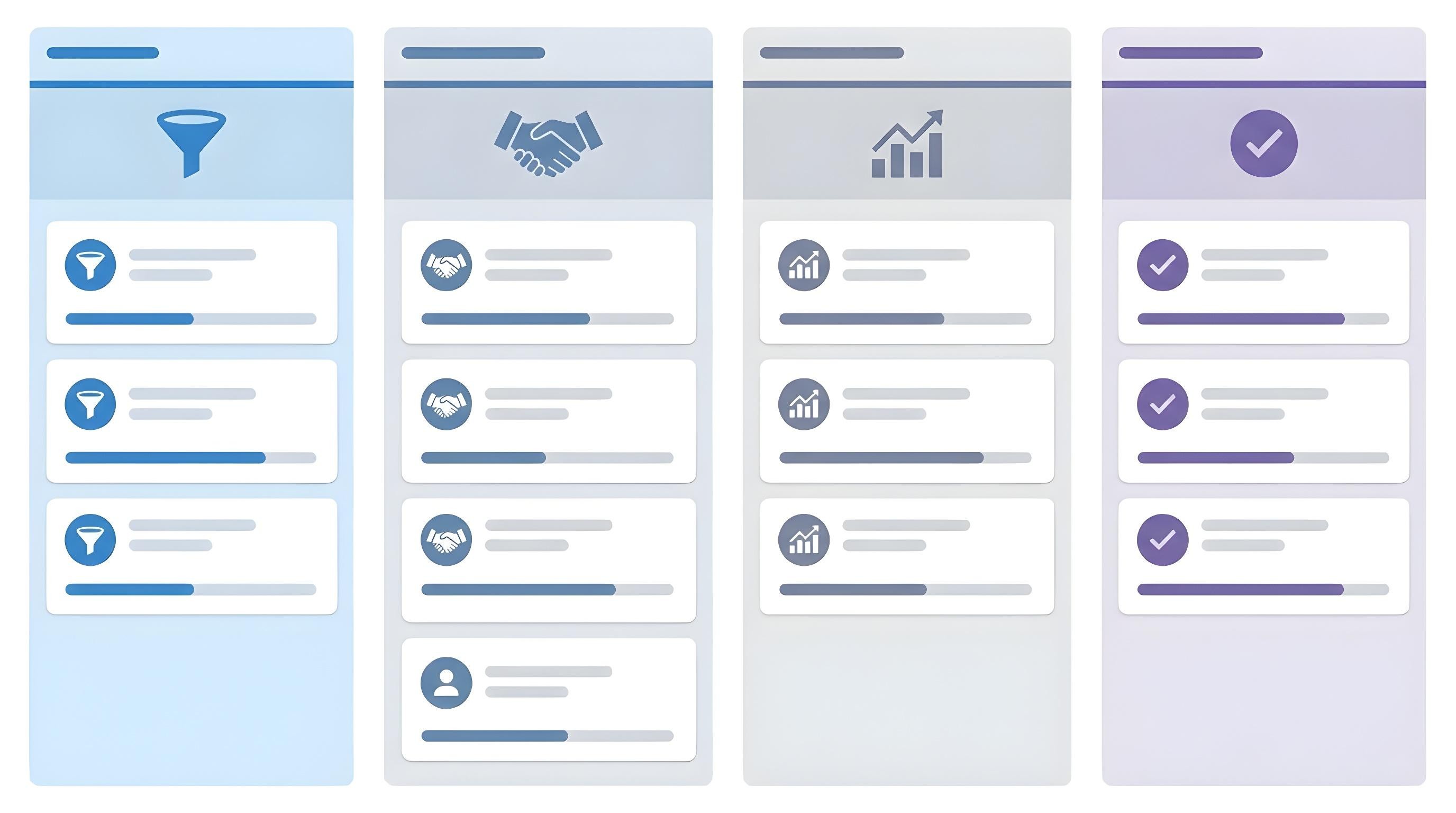
Sales pipeline. Shows each sales opportunity individually, with its value, stage, and owner. It is an operational view, useful for managing the team's day-to-day work.
Sales funnel. Shows the process in an aggregated way: how many leads enter, how many advance through the stages, and how many are lost at each point. It is an analytical view, useful for detecting where the overall process is failing.
What not to confuse
The sales pipeline and the sales funnel are complementary, not interchangeable. The funnel tells you what percentage of opportunities advance from one stage to another; the pipeline tells you exactly what those opportunities are, how much they are worth, and who is working on them. A sales team needs both views: the aggregated one to diagnose the system, and the individual one to manage each deal.
How to build a sales pipeline in B2B
Building a sales pipeline that is predictable, and not just a list of opportunities, requires following a specific process:
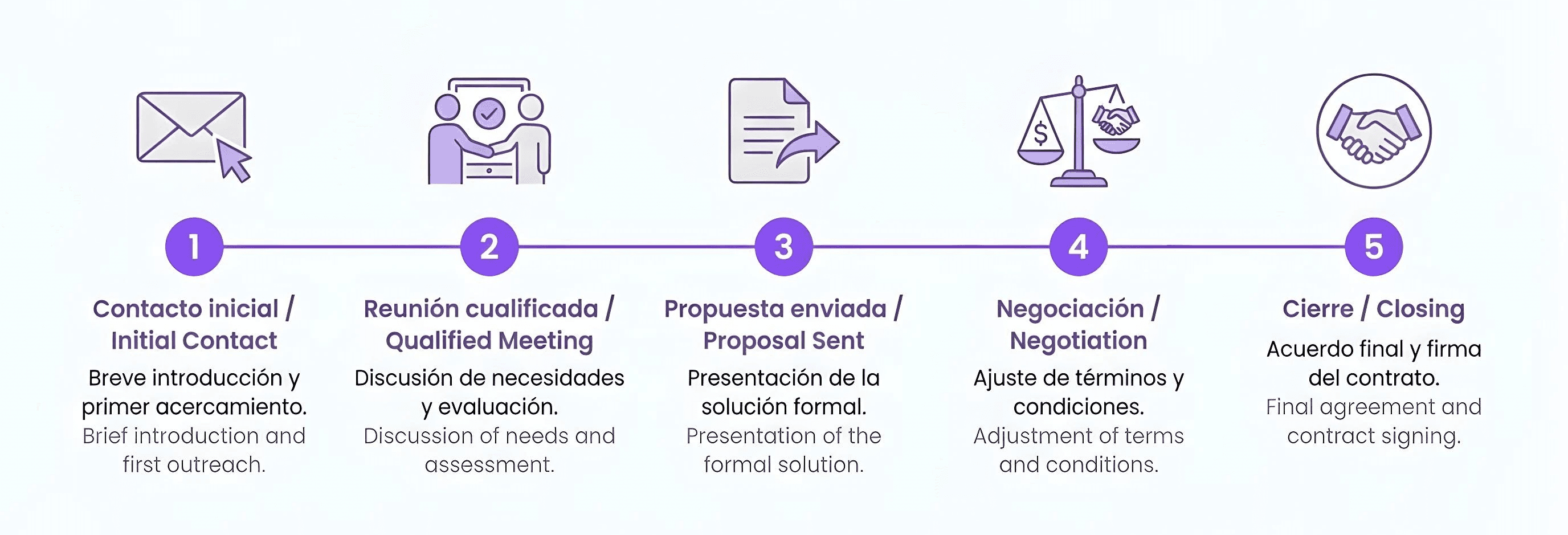
1. Define the stages of the process. The standard in B2B is: initial contact, qualified meeting, proposal sent, negotiation, closed won or lost. The number of stages depends on the complexity of the sales cycle.
2. Establish advancement criteria per stage. Each stage needs an objective condition to move to the next, not a feeling. For example: "moves to proposal sent" only when the document has been sent and confirmed by the client.
3. Assign a value and probability to each opportunity. The value is the potential amount of the deal; the probability is the estimated close rate based on its current stage. This is what allows you to calculate a realistic forecast.
4. Define an owner per opportunity. Every deal needs a clear owner. Without an assigned owner, no opportunity advances on its own.
5. Configure the CRM to reflect these stages. The sales pipeline only works if it lives in a system that the team updates constantly, not in a parallel spreadsheet that nobody maintains.
The most common mistake in this step is copying a generic stage model from the internet without adapting it to the company's actual sales cycle. A sales pipeline that does not reflect how you actually sell generates false data, and a false forecast is worse than having no forecast at all.
How to manage and prioritize deals in the pipeline
Having the sales pipeline built is only the first step. Managing it well is what actually drives results:
Mandatory weekly review. Every opportunity must be reviewed at least once a week. A deal that does not move for several weeks is a red flag, not something to ignore.
Prioritize by combined value and probability. A large deal with a low probability does not always deserve more attention than a medium-sized one with a high probability of closing this week.
Clean the pipeline regularly. Opportunities that have been stalled for months without progress artificially inflate the pipeline and distort the forecast. They must be marked as lost if there is no real evidence that they will move forward.
Identify stagnation patterns. If multiple opportunities get stuck in the same stage, the issue is not with individual sales reps: it lies in the process or the messaging at that specific stage.
A typical example: if 40% of opportunities get stuck right after sending the proposal, the problem is likely not the closing technique, but rather how the price or value is being presented in that document. When reviewed with this logic, the sales pipeline stops being just a record and becomes a diagnostic tool for the entire sales process.
Key metrics to measure the pipeline
A sales pipeline is managed with data, not with feelings. The most critical metrics are:
Pipeline volume. The total value of active opportunities, typically measured as a multiple of the sales target for the period.
Pipeline velocity. The average time it takes for an opportunity to move from one stage to another, and to close from the moment it enters.
Conversion rate between stages. The percentage of opportunities that advance from one stage to the next, critical for detecting bottlenecks.
Coverage ratio. The relationship between the total value of the pipeline and the sales target. A low ratio indicates that the target for the period will not be met.
Consistently measuring these metrics is what turns the sales pipeline into a real management tool, rather than just a record of opportunities.
SalesDose: how we structure the pipeline with our clients
A sales pipeline that looks organized in the CRM can still be a work of fiction if no one audits it critically. The difference between a decorative pipeline and one that predicts actual revenue lies in how it is designed from day one, not in how many columns the board has.
That is why we start with consultoría comercial to map your actual sales cycle and define stages with verifiable, non-generic criteria. That design is supported by automatización de procesos to ensure the CRM reflects reality without relying on manual updates, and by adquisición de clientes so that the pipeline never runs out of qualified opportunities.
If your sales pipeline exists but does not provide real visibility into your business, hablá con nuestro equipo.
Frequently asked questions about sales pipeline
These are the most common questions that arise when building or reviewing a sales pipeline in B2B teams.
What is the difference between a sales pipeline and a sales forecast?
The sales pipeline is the complete list of active opportunities with their stage and value; the sales forecast is the projection of how much of that pipeline will convert into real revenue in a specific period. The forecast is calculated based on pipeline data, applying the closing probability of each stage to the value of each opportunity.
How many stages should a sales pipeline have?
There is no fixed number. In B2B, between 4 and 6 stages is standard, depending on the complexity of the sales cycle. The critical factor is not the quantity, but that each stage has a clear, verifiable advancement criterion, rather than a subjective impression from the sales rep.
What does a healthy sales pipeline look like?
A healthy sales pipeline has sufficient volume to cover the sales target (typically 3 to 4 times the target, depending on the sector), moves at a steady pace between stages, and does not have opportunities stalled for weeks without activity or updates.
Should the sales pipeline be managed in a CRM or can it be an Excel sheet?
It can start in a spreadsheet when the volume of opportunities is very low, but to scale, it must live in a CRM. An Excel sheet does not send alerts, does not automate follow-up reminders, and becomes unmanageable as the volume of opportunities and the number of people updating it grow.
What happens if the sales pipeline is full but no sales are closing?
This usually indicates a quality issue with the opportunities or poor management of advanced stages, rather than a volume problem. You need to review whether the advancement criteria are too loose, whether opportunities in negotiation are receiving proper follow-up, and whether the team is qualifying effectively before adding a lead to the pipeline.
If your last pipeline meeting ended with more questions than answers about what will actually close this quarter, the problem is not reporting: it is design.
Does your sales pipeline give you certainty or is it just taking up space in your CRM? Let us audit it in our consultoría de estrategia de ventas b2b


Complete the form