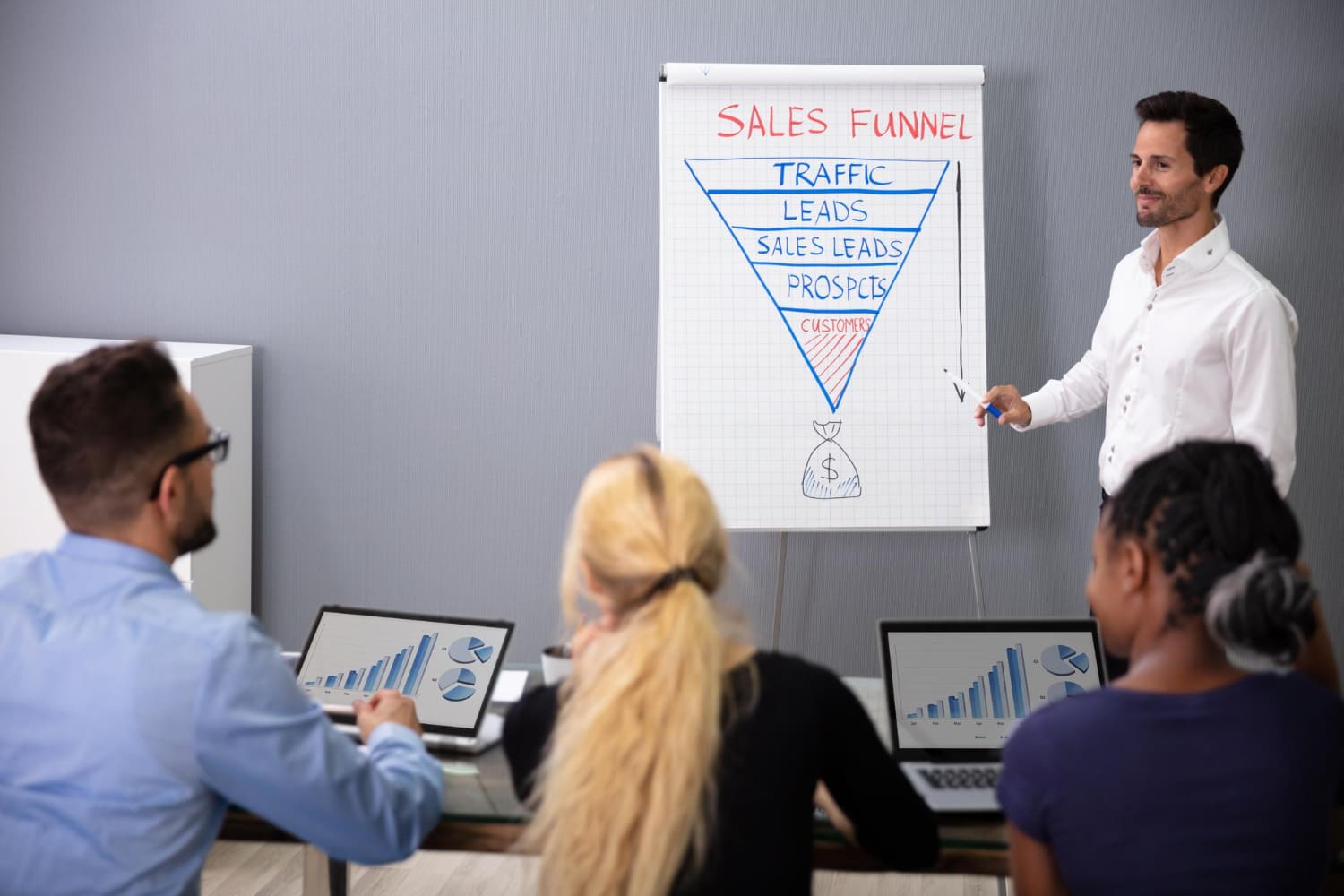
Sales funnel: key points
Understanding what a sales funnel is means understanding the structured journey a prospect follows from first learning about the company until becoming a customer.
A well-designed conversion funnel not only attracts prospects: it qualifies them, nurtures them, and converts them through a reproducible process at every stage.
The B2B sales funnel has distinct stages: visibility generation, lead capture, qualification, presentation, closing, and account expansion.
The most important metric in the conversion funnel is not top-of-funnel volume: it is the conversion rate between stages. That is where deals are lost or won.
A sales funnel without a steady top-of-funnel filling system collapses within weeks. Structured outbound is the most effective lever for keeping it active.
SalesDose designs, implements, and optimizes the B2B conversion funnel: from demand generation to closing and account expansion.
Most B2B companies lose business without knowing exactly where. They have meetings, send proposals, follow up — but revenue is not predictable and no one is clear at which point in the commercial process the chain breaks. The answer is almost always in the same place: they do not have a well-defined funnel.
Understanding what a sales funnel is —and how to build it correctly in B2B— is the starting point for any company that wants to stop operating on intuition and start making data-driven commercial decisions. The funnel is not a theoretical concept: it is the map that shows exactly how prospects enter the system, what makes them move forward, and where they get lost.
In this guide, we explain what a sales funnel is in the B2B context, how it is structured, which metrics define each stage, and how to convert it into a predictable growth system. All of this is based on SalesDose's experience with over 100 B2B companies.
What a sales funnel is and what it is used for in B2B
A funnel —also called a sales funnel or conversion funnel— is the structured representation of the journey a prospect takes from the first contact with the company until they become a customer. It is called a funnel because at the top there are many prospects and, as they progress through the process, the number decreases until only the most qualified reach the close.
Understanding what a sales funnel is implies understanding its real function in B2B: it is not just a conceptual diagram. It is the system that allows you to identify how many opportunities are in each stage, what percentage moves from one to the next, and where the greatest loss of business occurs. Without this visibility, improving the commercial process is impossible because you do not know what is failing.
A well-built funnel has three direct effects on the business: it makes revenue predictable —because you can calculate how many prospects are needed at the top to close the month's goal—, it allows you to prioritize the sales team's resources —because you know which phase has more leverage—, and it facilitates the early detection of problems —because a drop in the conversion rate of a specific stage is an alarm signal before it impacts revenue.
What distinguishes a sales funnel that generates results from one that only consumes resources
Many B2B companies have a funnel defined on paper that does not work in practice. The difference between a funnel that generates results and one that does not lies in three elements:
Clear qualification criteria at each stage
A funnel that works has precisely defined conditions that a prospect must meet to advance from one phase to the next. Without these criteria, salespeople put anyone who has replied to an email into the funnel, and the data loses all its predictive value.
Constant replenishment system at the top
The most common mistake is focusing on optimizing the closing stages and forgetting that the funnel needs a continuous flow of qualified prospects at the top. Without that flow, no matter how well the rest is designed: the system runs dry. Structured outbound is the most effective lever to ensure this replenishment predictably.
Metrics per stage and review cadence
A funnel without metrics is an invisible funnel. Each stage must have a measured conversion rate and a regular review cadence. When a rate drops below the expected threshold, it is the signal to investigate what is failing: the message, the prospect profile, the follow-up process, or the proposal.
How the conversion funnel works in B2B: stages and metrics
The B2B funnel has a stage structure distinct from that of B2C. Cycles are longer, there are multiple decision-makers, and the purchasing process is more complex. This is the funnel model that works for most B2B companies:
Stage 1: Visibility Generation
The very top of the funnel. The objective is for the ICP to know that the company exists and has a relevant solution to their problem. The main channels are direct outbound, SEO and content, organic LinkedIn, and digital advertising. The metric that defines this stage is reach: how many prospects from the ICP have had contact with the company.
Stage 2: Capture and Interest
The prospect has shown some type of interest: they have replied to an email, interacted with content, or requested information. In this stage of the funnel, the objective is to capture that interest and convert it into a qualified conversation. The key metric is the response rate or the conversion rate from visitor to identified lead.
Stage 3: Qualification
Not all prospects who show interest are actual potential clients. In this stage of the funnel, it is validated whether the prospect meets the ICP criteria: they have the problem that the solution solves, have budget available, have authority to decide, and have urgency. A well-designed funnel filters here rigorously so as not to waste sales team resources on opportunities that will not close.
Stage 4: Presentation and Proposal
The qualified prospect receives a demonstration or presentation of the solution and, if interest is maintained, an economic proposal. In this stage of the funnel, the conversion rate directly depends on the quality of the presentation, the alignment between the value proposition and the prospect's pain point, and the team's ability to handle objections.
Stage 5: Close
The prospect decides. In this stage of the funnel, the goal is to eliminate final friction: resolve final doubts, manage negotiations, and convert interest into a signed contract. The conversion rate in this stage is the most direct indicator of the effectiveness of the entire commercial process.
Stage 6: Account Expansion
A well-designed B2B funnel does not end at the close. Account expansion —upsell, cross-sell, and renewal— is the most profitable stage of the funnel because the acquisition cost is already amortized. Companies that integrate expansion into their funnel generate recurring revenue with a CAC significantly lower than that of new acquisition.
Summary of metrics per sales funnel stage
Visibility Generation: ICP reach, impressions, new contacts per week.
Capture and Interest: response rate, visitor-to-lead conversion rate.
Qualification: ratio of qualified prospects to total contacted.
Presentation and Proposal: meeting-to-proposal sent conversion rate.
Close: proposal-to-signed contract conversion rate, sales velocity.
Expansion: renewal rate, upsell ratio, NRR —Net Revenue Retention—.
How to build a B2B sales funnel that converts predictably
Designing a funnel that works in practice requires working backward: starting with the revenue goal and calculating how many opportunities are needed in each stage to reach that goal.
Step 1: Define the revenue goal and work backward
If the goal is to close 10 new clients per month with an average contract value of €5,000, and the proposal-to-close conversion rate is 30%, you need to send approximately 34 proposals. If the meeting-to-proposal conversion rate is 60%, you need about 57 qualified meetings. This exercise —applied to each stage of the funnel— tells you exactly how many prospects you need at the top of the funnel to reach the target.
Step 2: Define qualification criteria
Before activating any channel, define what conditions a prospect must meet to enter the funnel and to advance from one stage to the next. Without these criteria, the funnel fills with noise and metrics lose predictive value.
Step 3: Activate the replenishment system
The funnel needs a constant flow of qualified prospects at the top. Structured outbound —with SDRs proactively contacting the ICP— is the most effective system to guarantee that flow from the very first month. Inbound complements outbound as it matures.
Step 4: Measure and optimize by stage
Once the funnel is active, establish a weekly review cadence of metrics by stage. The objective is not reporting: it is to identify in which stage the conversion rate drops the most and prioritize improvement actions at that point. A funnel optimized stage by stage produces exponentially better results than one managed globally.
Common mistakes when building a B2B sales funnel
Designing the funnel without qualification criteria. A funnel without clear criteria is just a contact list. Qualification is what converts the funnel into a predictable system.
Focusing only on the closing stages. If the top of the funnel is not active, the system empties in weeks regardless of how good the closing process is.
Not measuring the conversion rate by stage. Without metrics by stage, it is impossible to know where the bottleneck of the funnel is.
Confusing activity with conversion. Making many calls or sending many emails is not advancing through the funnel. The only relevant metric is how many prospects advance from one stage to the next.
Not integrating account expansion. A funnel that ends at the close leaves the most profitable channel on the table: the expansion of current clients.
Not aligning the funnel with the pipeline. The funnel and the sales pipeline are complementary. The funnel shows the aggregate rates of the system; the pipeline shows the individual status of each opportunity.
How SalesDose designs and implements the B2B sales funnel of its clients
At SalesDose, we do not design funnels on paper: we build them, activate them, and optimize them to produce predictable revenue from the very first month.
SDR Outsourcing: we activate the top of the funnel with structured outbound that generates qualified meetings constantly, so that the client's sales team only has to manage the presentation and closing stages.
B2B Consulting: we structure the stages of the funnel, define the qualification criteria per stage, and train the team to manage each stage with methodology and data.
Systems lead generators: we design the omnichannel system that feeds the funnel constantly: outbound, inbound, and digital advertising coordinated in a single system.
Frequently asked questions about the sales funnel
What exactly is a sales funnel?
A funnel is the structured representation of the journey a prospect takes from the first contact with the company until they become a customer. It is called a funnel because at the top there are many prospects and, as they progress through the process, the number decreases. In B2B, the funnel includes qualification, presentation, and closing stages that can last weeks or months.
How many stages should a B2B sales funnel have?
There is no universally correct number, but in B2B a functional funnel usually has between 5 and 7 stages. What matters is not the number but that each stage represents a real advance in the prospect's level of commitment and has defined entry and exit criteria.
What is the difference between a sales funnel and a marketing funnel?
The funnel covers the process from when the prospect is identified as an opportunity to when they close. The marketing funnel covers the preceding process: how the unknown market becomes an identified prospect. In well-managed B2B, both are aligned: the marketing funnel feeds the top of the funnel and the sales team manages the rest.
How do you improve the conversion rate of the sales funnel?
The most effective way to improve the conversion rate of the funnel is to identify in which specific stage you lose the most business and act on that point. The most frequent causes of low conversion are: poorly qualified prospects entering advanced stages, value proposition misaligned with the prospect's real pain, lack of structured follow-up, or absence of urgency in the decision process.
How do the sales funnel and the sales pipeline relate?
The funnel and the pipeline are complementary tools used to manage the same process from different angles. The funnel shows the aggregate rates of the system —what percentage of prospects advance from one stage to the next—. The pipeline shows the individual status of each active opportunity. The most effective B2B sales teams use both: the funnel for strategy and the pipeline for operations.
How long does it take for a well-built sales funnel to work?
With outbound active as the replenishment channel, a well-built funnel starts generating the first qualified opportunities in 2 to 4 weeks. Closing results depend on the length of each company's sales cycle, but the first reliable data on conversion rates per stage are usually available from the second month of consistent operation.
In summary: the sales funnel is the system that converts prospects into predictable revenue
Understanding what a sales funnel is and building it correctly in B2B is what separates companies that grow systematically from those that rely on luck or personal relationships. The funnel is not an abstract concept: it is the system that provides visibility on how business flows, where it is lost, and what needs to be changed to improve results.
A well-designed funnel has clear qualification criteria, a constant replenishment system at the top, metrics per stage, and a review cadence that allows you to detect problems before they impact revenue. When those four elements are aligned, the funnel produces predictable results month after month.
If you want to design and activate your company's funnel with a specialized team, SalesDose has the methodology and the team to do it. More than 100 B2B companies are already generating demand with us predictably.
Ready to build a B2B sales funnel that converts predictably? Speak with our SalesDose team →

Complete the form